
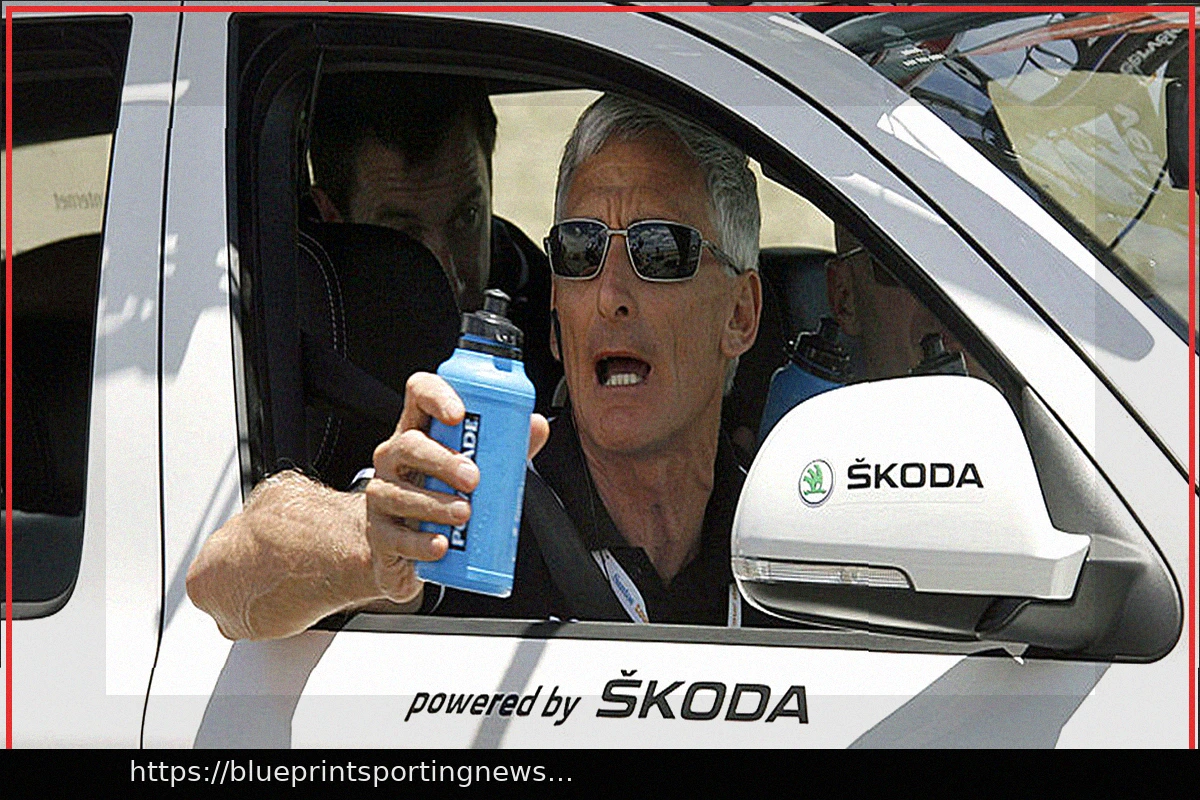

Interview: Allan Peiper, a former professional cyclist and respected team director, possesses an intimate understanding of the Tour of Flanders. Having lived along its route, competed in the race, and guided teams from the director’s car, his insights into the Ronde van Vlaanderen are unparalleled. This conversation with Peiper delves into his deep knowledge of the iconic parcours.

While casual commentary offers one perspective, true understanding often comes from those with firsthand experience. Allan Peiper is such a figure; he not only competed in the Tour of Flanders and Paris-Roubaix multiple times but also led teams as a sports director in both prestigious events.
His impressive career includes a top-10 finish in Flanders and orchestrating a victory for one of his riders in Paris-Roubaix. Peiper’s racing years spanned notable teams like Peugeot (1983-85), Panasonic (1986-90), and Tulip (1991-92). As a sports director, he accumulated vast expertise with Lotto, T-Mobile, High Road, Columbia, HTC, Garmin, BMC, and currently, UAE Team Emirates.

Question: You reside directly on the Tour of Flanders route?
Allan Peiper: Indeed, in Geraardsbergen. All the major races literally pass by my doorstep.
Question: Do you ever long for Australia’s sun and surf?
Allan Peiper: Cycling consumes my life so entirely that I rarely ponder it. However, come November, when the team activities and racing schedule slow down, that’s when the desire to return home truly surfaces!

Question: What are your thoughts on the updated Tour of Flanders route, featuring the Oude Kwaremont as part of the finishing circuit?
Allan Peiper: It undeniably deviates from the race’s rich historical essence; the sight of riders ascending the Muur in Geraardsbergen, past the chapel, is an iconic symbol of the event. Yet, circumstances evolve. With increased traffic and spectator numbers, and a greater focus on risk mitigation and potential issues, these factors must be considered. The revised course simplifies logistics, from parking to hospitality services, and allows spectators to witness the race multiple times without extensive travel across the region.
Question: In your racing days, did you undertake specific preparations for these major races?
Allan Peiper: Winter training was paramount, as the in-season schedule was packed with races. I trained diligently alongside Marc Sergeant and Dirk De Wolf. Once the season began, the calendar was set: races in Southern France, the Opening Weekend, Tirreno-Adriatico, and De Panne. A significant step for me was hiring trainer Ludwig van der Putte, who had previously coached Phil Anderson. He provided tailored interval workouts that greatly improved my ability to push over the peaks of climbs – a critical ‘top end’ power that distinguishes elite riders. His prescribed training regime proved immensely beneficial.

Question: You achieved some commendable results in Flanders.
Allan Peiper: I competed nine times. In 1987, I finished 10th. That year, during the ascent of the Old Koppenberg, a crash forced us to unclip from our toe clips and straps, while Criquielion, using Look pedals, quickly re-engaged and surged ahead, leaving us to walk up the climb. Behind him, a group of eight had formed. I attacked with Ronny Van Holen to bridge the gap but suffered two punctures on the Eikenberg. After a rapid wheel change, fueled by adrenaline, I rejoined the leaders, where my role was to lead out my team leader, Erik Vanderaerden. Criquielion ultimately won, and Kelly out-sprinted Erik for second, securing third for us. Two years later, in 1989, I placed seventh. Van Hooydonck made a decisive attack on the Bosberg, and the race was decided. Herman Frison finished second and Dag Otto Lauritzen third, with me crossing the line in the same time. In 1990, I was part of the breakaway with the eventual winner, Moreno Argentin, and Rudi Dhaenens, who placed second, though I finished 51st that day. I was consistently highly motivated for this race and often found myself in contention.
Question: And how many times did you participate in Paris-Roubaix?
Allan Peiper: I also rode Paris-Roubaix nine times, but I never approached it with the same level of motivation. Typically, I was assigned to support one of our team leaders in the early phases, and I had adopted the mindset that it simply ‘wasn’t my race.’ Despite this, I was actually in the early breakaway with Dirk Demol in 1988 when he ultimately won. I frequently found the experience somewhat anticlimactic; as I mentioned, my role was always to assist others, and my personal drive wasn’t quite there. Then, one year, during a pre-race interview alongside Roger De Vlaeminck, I again expressed my belief that ‘it wasn’t my race.’ Roger, however, dismissed this as baseless, asserting it was purely a mental block and that I possessed the talent to excel in Roubaix. His words instilled new confidence in me, and that year I was indeed in the thick of the action. However, with 30 kilometers remaining, one of my alloy bottle cages broke, and the other came loose, forcing me to discard it. Without bottles or food, my race was effectively over.
Question: Nevertheless, you were on the verge of claiming your own cobbled classic victory at the GP E3?
Allan Peiper: Yes, that occurred in 1988. I was alongside Guido Bontempi, and it was clear I couldn’t out-sprint him; he was one of the quickest riders of his time.

Question: Was there a notable disparity in how the Peugeot and Panasonic teams approached the major cobbled classics?
Allan Peiper: That disparity was a key factor in my departure from Peugeot. I recall a pre-Flanders team meeting with Peugeot where some riders were openly discussing at which feed station they planned to abandon the race. I tried to arrange a reconnaissance ride for Flanders, but only three out of the eight-man race squad actually participated. Back then, these races were largely dominated by Belgian and Dutch riders; while you’d occasionally see a talent like Altig from Germany or Moser from Italy, the peloton was far less international, and television coverage was incomparable to what it is today.

Question: What stands out as your fondest memory of Paris-Roubaix in your role as a sports director?
Allan Peiper: Greg Van Avermaet’s victory is definitely it. He had just experienced the disappointment of finishing second to Philippe Gilbert in Flanders. Then, early in Roubaix, he suffered a puncture, but the team executed a flawless, calm chase to bring him back to the front, perhaps allowing him to conserve more energy than those already at the sharp end of the race. We then had Daniel Oss positioned perfectly to lead him into the crucial Carrefour sector – it was an exceptional day. I’ve been close to a victory in the Tour of Flanders as a DS, but haven’t quite clinched it yet; that remains firmly on my ‘bucket list’.

Question: Do you believe Alex Kristoff has a strong chance?
Allan Peiper: Absolutely, he’s a definite contender. He’s incredibly resilient and possesses immense power, but the Oude Kwaremont isn’t ideally suited to his strengths. In the Tour of Flanders, a significant degree of luck and favorable circumstances are always essential.

Question: UAE Team Emirates is a highly diverse, international squad. Is it challenging to replicate the same intense motivation for these specific races that Belgian and Dutch riders naturally possess?
Allan Peiper: Yes, it is. For Belgian riders, the Tour of Flanders transcends a mere competition; it’s a national festivity, a race they would sacrifice everything to win. It mirrors the sentiment Italian riders have for Milan-Sanremo; most would prioritize winning that classic over a World Championship title.

Question: Greg Van Avermaet consistently aims for a Flanders victory, but he didn’t appear in top form at Wevelgem?
Allan Peiper: Wevelgem isn’t truly his ideal race, yet I was somewhat taken aback not to see him at the forefront on the Kemmel. However, much like Kristoff, if a race is lengthy, demanding, and arduous, he retains his power and finishing speed, making him a formidable contender at the end.
Question: Thank you for your insights, Allan. We wish you and your team a successful race on Sunday.
Allan Peiper: As I’ve mentioned, I’ve had several opportunities to secure a victory in this race as a sports director, but it has always eluded me. To finally achieve that would indeed be wonderful.
