

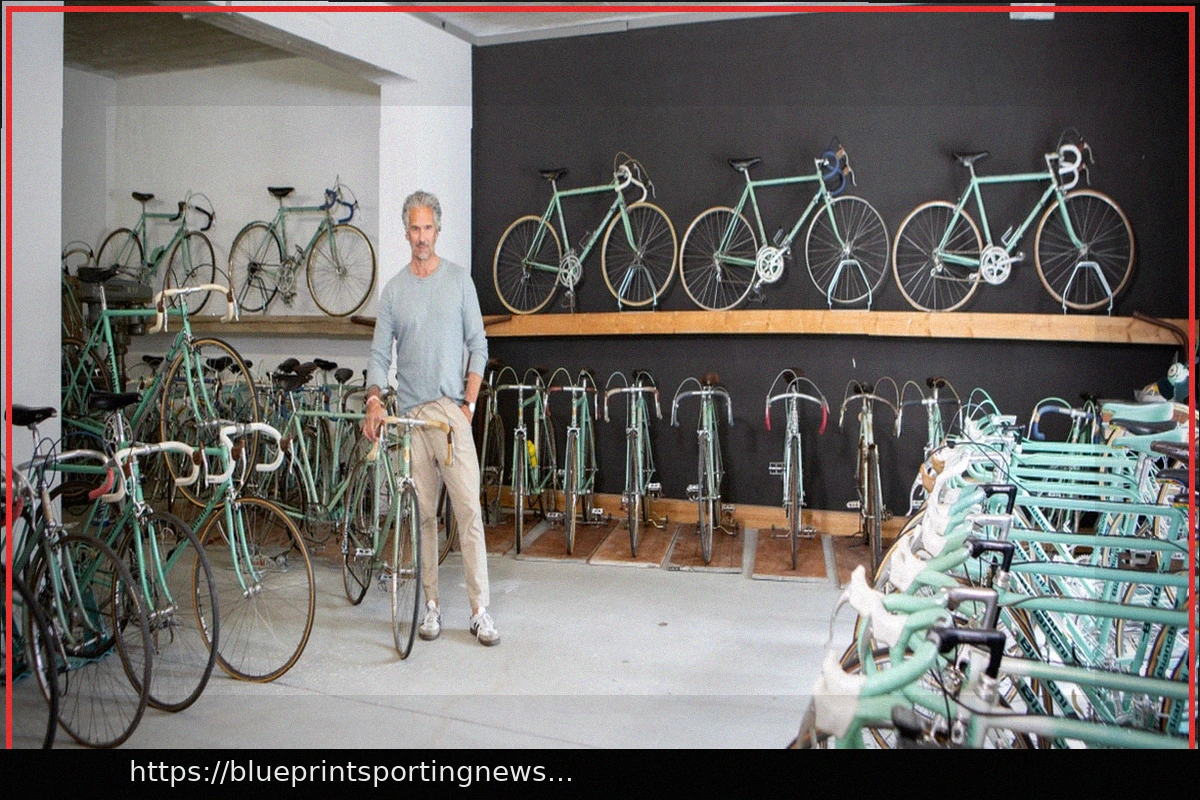

Following our October review of “The Vintage Bianchi Book,” we are thrilled to present an interview with the exceptional collector, Carsten Rademacher. Known as “Dottore Bianchi,” Rademacher is the curator and custodian of the impressive collection showcased in the book. He enthusiastically shared his deep-seated passion for the iconic celeste bicycles with us, especially as an open edition softcover version of the book is now available.

Interviewer: The book indicates that your immersion into the world of vintage Bianchis began with your participation in l’Eroica in Tuscany in 2013. What was your experience with cycling before that significant event?
Carsten Rademacher: Like most people, I learned to ride a bike as a child, but as an adult, I didn’t have any particular interest in it. A friend stumbled upon an article about l’Eroica and suggested we try this “crazy ride” on old bicycles in Tuscany. I didn’t even own a bike at the time! My friend set me up with a 1970s Gazelle Champion, and it was a revelation. I had never ridden a racing bicycle before and was absolutely amazed by its responsiveness and light weight. It was incredibly fun. Later, during a ride, I met an older gentleman who was riding a Bianchi. I was immediately struck by the unique celeste color, and when we chatted, he mentioned he was considering stepping away from cycling. The outcome was that I purchased his Specialissima, a premium model crafted by Bianchi’s Reparto Corse racing department. That’s the bike I took to l’Eroica.
Interviewer: What was your overall impression of l’Eroica?
Carsten Rademacher: It was truly an eye-opening experience for me. There were so many beautiful bicycles, and an even greater number of Bianchis! I signed up for the “medio” 135 km route. When I reached the 100 km mark, I stopped to call my wife and tell her that, for the first time ever, I had ridden that distance on a bicycle. But there were still 35 challenging kilometers left, and it became quite a struggle towards the end. Despite the difficulty, I haven’t missed an edition of l’Eroica in Chianti since then. I’ve also participated in other Eroica events in the Netherlands and Germany, as well as various other retro rides.

Interviewer: Given your newfound enthusiasm for vintage bicycles after this experience, how did you begin to assemble your collection?
Carsten Rademacher: I started by acquiring a broad spectrum of classic Italian racing bikes, spanning from Pogliaghi to Gios. However, by 2016, I realized that my true passion lay with Bianchis, so I decided to sell the other brands. The celeste color had an immediate and powerful emotional impact on me. What began as a purely aesthetic attraction gradually deepened into a profound appreciation for Bianchi’s unique and continuous historical legacy. Bianchi represents an unbroken racing identity that dates back to the late 19th century, embodying a remarkable combination of craftsmanship, rich history, and significant cultural importance.
Interviewer: Collections naturally evolve over time. Even with your singular focus on Bianchi, how did you strategically build your collection?
Carsten Rademacher: Initially, I gravitated towards more recent models. However, as I forged connections within the vintage bicycle community, my contacts began offering me some truly remarkable machines. This led me to refine my focus: I decided to collect Bianchis with impeccable provenance and comprehensive documentation. In addition to the bicycles, I also gather memorabilia, which includes everything from team jerseys to vintage advertising items and water bottles.
Interviewer: Your Bianchi collection spans a period from the 1920s right up to the late 1980s. What is the particular significance of these chronological boundaries?
Carsten Rademacher: One of the bicycles highlighted in the book is a 1989 Proto model. These TIG-welded frames were produced between 1987 and 1992 and, to me, represent the final significant era of steel bicycles from Bianchi.

Interviewer: Which pieces do you consider to be the absolute jewels of your collection?
Carsten Rademacher: I am fortunate to own bicycles that were ridden by legendary professional racers such as Rudi Altig, Felice Gimondi, and Johan De Muynck, among many others. However, perhaps the most thrilling piece in my collection is a 1949 Leggerissimo, bearing Serial Number 171826, which was specially built for Fausto Coppi. Seven bikes were custom-made for Coppi that year—five for road racing and two for track events. This specific example was the sixth of those seven. The documentation accompanying this bicycle includes its official listing in the so-called “Pinella Register,” a meticulous record of bikes produced by the Reparto Corse. Interestingly, Reparto Corse bicycles intended for team use in later years had serial numbers commencing with “999,” a number we coincidentally chose for the total copies of the limited edition version of our book!

Interviewer: Many of the bicycles featured in your book appear to be in remarkably excellent condition. Do you perform any restoration work on them yourself?
Carsten Rademacher: None of the bicycles in my collection have ever been repainted. Some, like the 1985 Centenario, have seen incredibly little use, while many of the older bikes naturally display the authentic signs of their age. I firmly believe that this natural patina eloquently tells the machine’s history, so scratches or other marks are entirely acceptable. That said, I do make a concerted effort to find bicycles in the best possible original condition.

Interviewer: Do you ever take any of the bicycles from your esteemed collection out for a ride?
Carsten Rademacher: Oh, absolutely! Naturally, some are strictly off-limits—crashing Coppi’s bike, for instance, would be an unforgivable act! And some of the much earlier bikes, those from the 1920s and 1930s, are nearly a century old and, quite understandably, a bit fragile. Perhaps my favorites for actual riding are the Bianchis that were used by the Gewiss Team in the 1980s; I currently boast a fine selection of eleven of those!
Interviewer: Which other professional teams that utilized Bianchi bicycles are represented in your collection?
Carsten Rademacher: Alongside bikes simply branded “Bianchi,” my collection includes models associated with teams such as Bianchi-Piaggio, Bianchi Faema, Mobylette, Salvarani, and Sammontana… there’s an incredibly rich and extensive history connecting Reparto Corse bicycles with professional cycling teams.
Interviewer: There are several bicycles in your collection that are equipped with the early Campagnolo Cambio Corsa and Paris-Roubaix shifting systems. These mechanisms notably require the rider to pedal backward and reach behind and downwards along the seatstay to execute a shift. Have you ever actually ridden one of these bicycles and attempted to shift gears using this method?
Carsten Rademacher: Well, I can confidently say that I have ridden a bicycle featuring this system, but I have not yet dared to attempt the shifting maneuver while in motion!
Interviewer: The descriptions provided in your book are remarkably detailed. They even highlight the subtle evolutionary changes within models that were often produced over long periods. Considering you only became what one might term a “serious” collector roughly a decade ago, how did you manage to acquire such an extensive and intricate knowledge about the Bianchi brand?
Carsten Rademacher: I’ve been incredibly fortunate to receive generous assistance from numerous experts in the field, primarily from Italy. These individuals possess an intimate familiarity with every nuance of Bianchi models, and I have greatly benefited from their invaluable help. There are also several specialist publications dedicated to Bianchi. Furthermore, the Registro Storico Cicli, a wonderful organization based in Umbria, has members who undertake meticulous research on vintage bicycles, which has also proven extremely useful to my understanding. With such a wealth of facts and information at my disposal, my friends have affectionately started calling me “Dottore Bianchi.”

Interviewer: What are your future plans and aspirations for the collection?
Carsten Rademacher: I was very lucky to be able to house some of the bicycles in a building near my home that once served as a warehouse for a local bike shop. I truly enjoy spending time in my “Vintage Bianchi Room,” though I’ve certainly been reminded about the conspicuous absence of a fine Italian espresso machine there! As the years progress, I increasingly view myself not just as a collector, but as a curator or custodian of these magnificent bicycles. Recognizing their immense historical importance, my primary goal is to meticulously maintain and document them to the fullest possible extent. It has been an absolute pleasure to collaborate on the book with my fellow enthusiasts, ensuring that many more people can share in the profound enjoyment I derive from this collection.
