

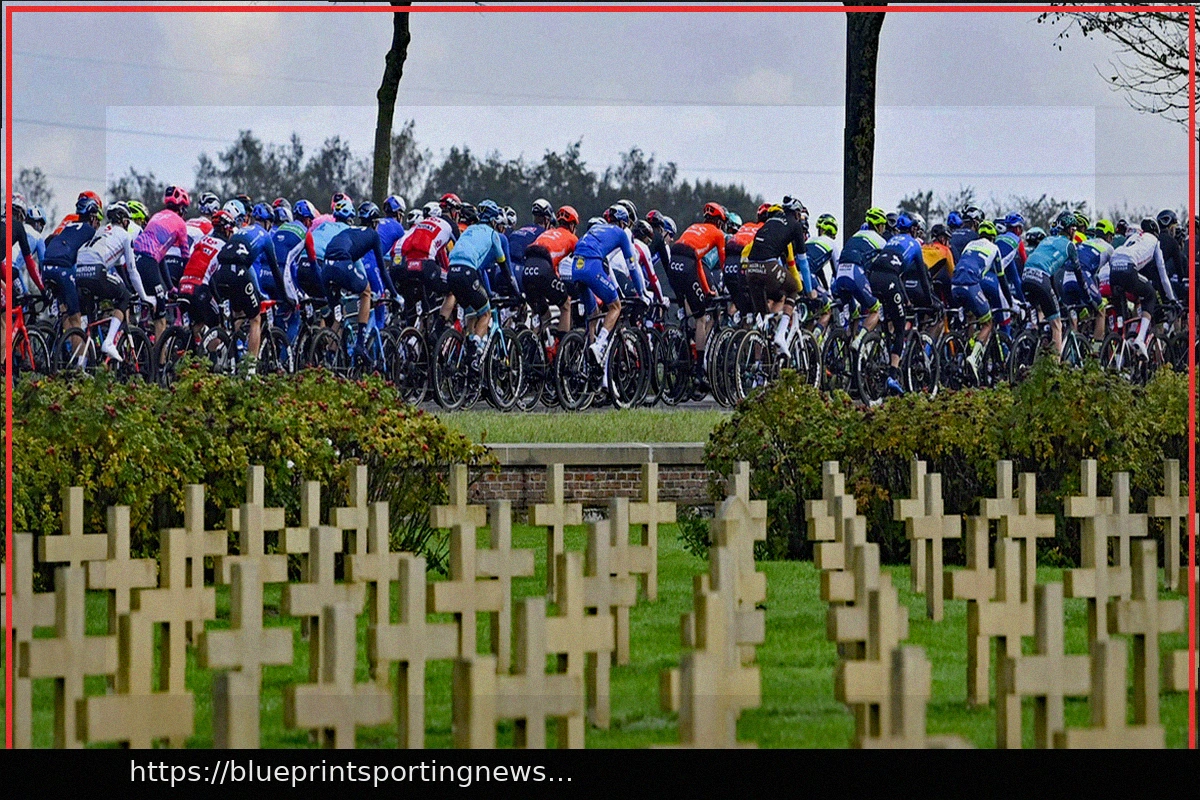
Gent-Wevelgem embodies the unique challenge and unpredictable allure of the Spring Classics. This renowned race, where sprinters can seize victory or be thwarted by relentless winds, unforgiving cobbles, and the notorious slopes of the Kemmelberg, has forged a legacy through its roster of champions, from Eddy Merckx to Tom Boonen and Peter Sagan. Traversing the historic landscapes of Flanders Fields, Gent-Wevelgem’s deep history consistently reminds us that anything can unfold on the road to Wevelgem, cementing its status as one of cycling’s most captivating single-day battles.
The inaugural Gent-Wevelgem took place on September 9, 1934, with Gustave Van Belle claiming a solo victory after 120 flat kilometers, finishing 20 seconds ahead of his competitors. Initially organized for amateur cyclists by the newspaper Gazet van Antwerpen, the race concluded in Wevelgem, the hometown of its first proprietor, textile magnate Georges Matthijs. It was originally conceived as a tribute to Gaston Rebry, a prominent Belgian cyclist of the 1930s who hailed from Wevelgem.
In 1936, the race distance was extended to 168km, and Robert Van Eenaeme emerged victorious. Following a hiatus during the Second World War, Gent-Wevelgem returned in 1945, now for professional riders, and Van Eenaeme remarkably secured his second win. The final results that year required ten days to confirm, pending a meticulous review of the photo finish. By this time, Gaston Rebry served as president of ‘Het Vliegend Wiel’ and acted as race director. In 1947, Gent-Wevelgem was moved to its now-familiar Spring slot on the calendar, rapidly gaining prestige. Rebry successfully attracted Italian cycling giants Gino Bartali and Fausto Coppi, drawing immense crowds of spectators.
Throughout the 1950s, 60s, and 70s, Belgian cycling icons Rik Van Looy and Eddy Merckx each triumphed in the race three times. Van Looy’s 1962 victory was particularly notable, as he also won the Tour of Flanders and Paris-Roubaix in the same year. Two years later, Jacques Anquetil became only the second non-Belgian winner, following Switzerland’s Rolf Graf in 1954.
From the 1980s onwards, Gent-Wevelgem increasingly favored sprinters, with notable winners including Guido Bontempi, Sean Kelly, and Mario Cipollini. The Italian “Lion King” Cipollini recorded three victories, establishing himself as one of the race’s record holders. In 2003, the race start moved from Gent to Deinze, a year won by Andreas Klier. The following year, a young Tom Boonen began his streak of three victories. His triumphs in 2003, 2011, and 2012 (as per the source text) also secured his place as a multiple record holder. The year 2011 saw the race’s inclusion in the WorldTour. In 2014, the event was officially rebranded as Gent-Wevelgem in Flanders Fields, a poignant reference to John McCrae’s renowned First World War poem, “In Flanders Fields.” This name also highlights the route’s passage through several significant sites from the Great War. Since 2020, the race no longer commences in Gent or Deinze but in Ieper (Ypres).
No single rider holds the absolute record for wins; Robert Van Eenaeme, Rik Van Looy, Eddy Merckx, Mario Cipollini, Tom Boonen, and Peter Sagan have each won Gent-Wevelgem three times.
The 2022 edition saw a reduced peloton approach the Kemmelberg, where the decisive moves typically unfold. Wout van Aert accelerated fiercely, with only a handful of favorites able to maintain pace, yet the main group remained largely intact. Eventually, a quartet of riders—Christophe Laporte, Jasper Stuyven, Biniam Girmay, and Dries van Gestel—managed to break away. Despite attempts by Rasmus Tiller and Greg Van Avermaet to bridge the gap, they were unsuccessful. With 15 kilometers remaining, the leaders held a 15-second advantage, setting the stage for a sprint finish in Wevelgem. Laporte found himself at the front, allowing Girmay to launch his sprint first. Girmay successfully held off Laporte, securing a historic victory as the first African winner of a Spring Classic.
In 2023, Wout van Aert famously gifted the victory to his teammate Christophe Laporte after an impressive two-man effort. The 2024 race featured a similar two-man finale, but without the same gesture of teamwork at the finish. Mads Pedersen (Lidl-Trek) and Mathieu van der Poel (Alpecin-Deceuninck) had decimated the field, remaining as the sole contenders after the final ascent of the Kemmelberg. At the finish line, Pedersen edged out the Dutch World Champion to claim the win, with Jordi Meeus (BORA-hansgrohe) leading the peloton across the line 16 seconds later.