

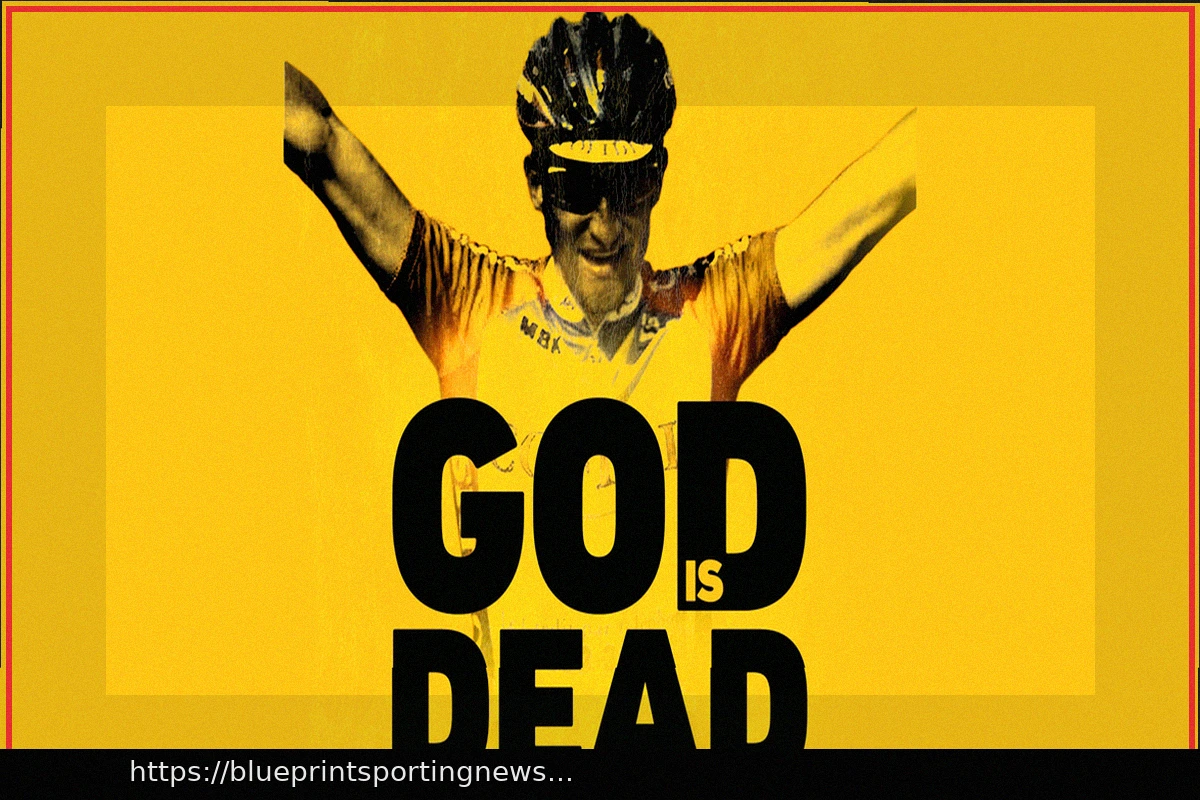

Frank Vandenbroucke, known affectionately to his fans as “God” or “VDB,” set the professional cycling world ablaze in the late 1990s with his electrifying performances and audacious style. Yet, his meteoric career was fleeting, ending tragically in a humble African hotel room after a decade of precipitous decline. The public often finds itself drawn to the lives of celebrities whose once-charmed existences unravel so dramatically.

Andy McGrath, previously the editor of “Rouleur” magazine, has authored what is believed to be the first English biography of Frank Vandenbroucke, titled “God is Dead.” McGrath is an accomplished writer, having also penned a book about Tom Simpson, another professional cyclist whose life ended prematurely under different circumstances. The book delves deep into the life of this complex personality, a figure often supremely confident yet surprisingly susceptible to external influences.
The narrative commences with Vandenbroucke’s childhood in Ploegsteert, a small Belgian village administratively associated with Wallonia despite its geographical location. VDB’s cousin vividly described Ploegsteert as “le trou du cul du monde” (the backside of the world), conveying its remote nature. Vandenbroucke hailed from a family steeped in cycling; his father, Jean-Jacques, and uncle, Jean-Luc, were both racers. The book also touches upon his uncle, Jean-Paul, a devoted supporter who struggled with drug addiction and shared some of Frank’s personality traits before his own early demise.

McGrath paints an evocative picture of young Frank’s upbringing in his parents’ lively village bar. An energetic child, he was a favorite among the customers. However, at five, a serious accident involving a rally car left him hospitalized for six weeks, resulting in his left leg being shorter and thinner than his right. This detail is particularly striking given that VDB, the racer, was renowned for his fluid and elegant style on the bike.
With his father’s steadfast encouragement and coaching, VDB joined a local sports club at seven and was fiercely racing by nine, displaying a powerful competitive streak. His father, a former racer, transitioned to managing the Lotto pro team and served as a mechanic for the Belgian national team. In 1989, at just fourteen, Frank accompanied his father to Chambery and joined professional cyclists on a training ride up Mont Revard—where they were unable to drop him.
In 1991, he claimed the Belgian national championship for neophytes. Despite being underage, he received a special dispensation to compete at the 1992 World Junior Cycling Championships in Athens, where he secured third place. A year later, he turned professional, initially joining the Lotto team managed by his uncle, Jean-Luc. Feeling it was a poor fit, Frank soon moved to the formidable Mapei-GB-Latexco superteam, led by Patrick Lefevere, an unusual blend of Belgian and Italian riders. After three years there, he transferred to the French Cofidis squad, where he raced from 1999-2000.

Over these six years, Vandenbroucke amassed over 80 victories, including prestigious races such as Gent-Wevelgem, Paris-Nice, Omloop Het Volk, and Liège-Bastogne-Liège, alongside stage wins and the points classification at the Vuelta. However, at Cofidis, the “Golden Boy’s” story began its tragic descent. He enthusiastically embraced the team’s drug culture, notably influenced by Philippe Gaumont, a French cyclist and fervent doper who later died prematurely. The misuse of sleeping pills, initially taken to aid sleep after races, when combined with alcohol, led to peculiar behavior, memory loss, and a lifelong addiction that would plague Vandenbroucke.
1999 marked the pinnacle of Vandenbroucke’s career, highlighted by his victory in Liège-Bastogne-Liège and his strong performance in the Vuelta, reportedly driven by a desire to impress a Saeco hostess (which, for a time, succeeded). It was also the year he met Bernard Sainz, a controversial cycling insider widely known as “Dr. Mabuse,” despite having no medical training. Sainz’s enigmatic nature and influence on Vandenbroucke remain a peculiar aspect of the story.
One of the book’s significant strengths lies in the author’s extensive interviews with several individuals who were central to Vandenbroucke’s life, either influencing him or being influenced by him. While his own autobiography, “Ik ben God niet” (“I am not God”), and another biography by a Belgian journalist (not involving McGrath’s project or VDB’s parents) exist, McGrath garnered insights from others. Sainz emerges as an important, ambiguous figure who held a remarkable sway over Vandenbroucke, almost practicing a form of “witchcraft.” This occurred even as Frank sought psychological help from Jef Brouwers. Brouwers’ observations on VDB’s personality are illuminating, as are his reflections on how he, like many others, was captivated by “Franky Boy.” Despite often hurtful and thoughtless behavior, Vandenbroucke’s charm and exceptional intelligence—he was fluent in four languages and possessed a great sense of humor—often led people to forgive him, though he displayed the will of a spoiled child.

Following his 1999 peak, his career dramatically declined. In the subsequent decade, he won only a single minor UCI-sanctioned race—a time trial at the Boucle d’Artois. While he came close to a major victory in 2003, making Peter van Petegem fight hard for his win, this was attributed solely to VDB’s immense natural talent, not consistent training. Between 2001 and 2009, he signed with eight different teams, often failing to even appear for them. In 2006, he even rode an amateur Gran Fondo in Italy under the pseudonym Francesco del Ponte.
The end came under somewhat mysterious circumstances in a modest hotel room in Senegal. His final years were marked by car crashes, suicide attempts, rampant drug use, frequent relocations, and financial ruin. His fan club in Ploegsteert dwindled significantly. Yet, friends and family continue to gather at the now-reowned bar on the anniversary of his death to honor his life.
The closest parallel in professional cycling to Frank Vandenbroucke’s life is arguably Marco Pantani, who also died tragically in a hotel room at 34, battling drug abuse and struggling to cope with celebrity. Pantani remains a cherished figure in Italy, but VDB’s reputation in Belgium is less certain, given his shorter period of glory and extended decline.
Does “God is Dead” truly reveal the authentic Frank Vandenbroucke? As the author states in his introduction:
“Life is never simple or necessarily fair, either, and there are many shades of grey among all the black and white. You can do wrong and still be wronged by people and systems around you. You can fulfill a great deal of promise and still squander so much. And you can be adored by so many and still be chasing love till your dying day.”
“God is Dead” is a superbly written and captivating book, offering a profound meditation on the tumultuous nature of celebrity and the often unforgiving world of professional cycling. It is a book that, despite knowing its tragic conclusion, is impossible to put down.

“God is Dead—The Rise and Fall of Frank Vandenbroucke, Cycling’s Great Wasted Talent” by Andy McGrath.