

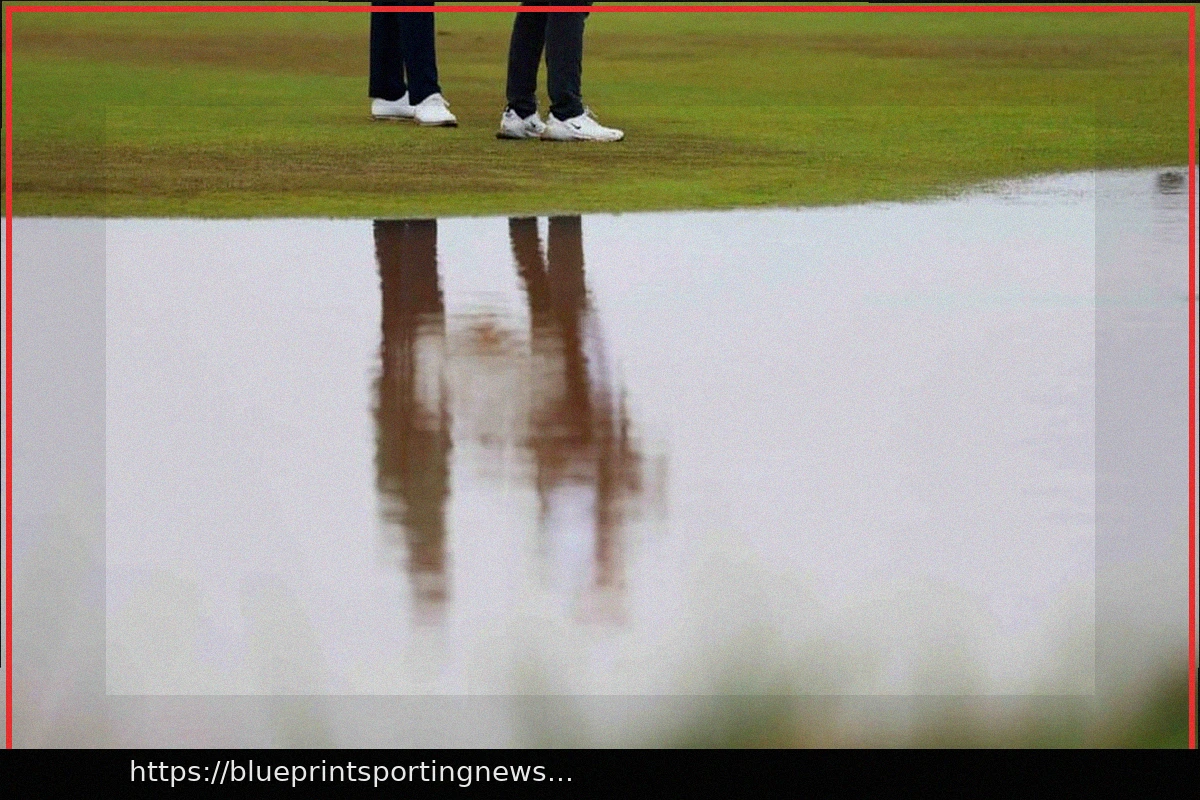
Walking across golf courses these days often means squelching through turf. Many fairways are reduced to bare earth, with aeration holes struggling to drain water from the saturated ground.
Areas away from the main playing surfaces look less like a golf course and more like a site recently vacated by a music festival. It’s an undeniable muddy mess, scarred by deep footprints and trolley tracks, leaving temporary marks everywhere.
Despite this grim reality, the clock is ticking down to the start of the competitive golf season. One has to wonder, what exactly are we doing?
This past winter has been among the wettest in nearly two centuries of record-keeping. For those in regions like the West Midlands, Cornwall, or Leicestershire, it was the wettest winter they’ve ever experienced.
Southern England and Northern Ireland saw their wettest winter in a decade. Disturbingly, this extreme weather is no longer an anomaly.
The winter of 2023 saw more rainfall than in the preceding 40 years, and in 2024, severe flooding caused widespread course closures.
While some assure me that recovery will be swift once temperatures rise, my current weather forecast predicts rain on eight of the next fourteen days.
I believe greenkeepers across the UK have once again performed miracles just to keep our courses open at all over the last couple of months.
However, they are not magicians. There’s only so much that can be done, even when temperatures eventually begin to climb.
Producing the kind of playing surfaces we desire for the traditional golf competition season is becoming increasingly difficult. Yet, that season is scheduled to begin very soon.
Hardly any club will be without a competition scheduled for the first weekend of April. Many even kick off in late March. Simply put, we are not ready.
Yes, we still implement preferred lies, likely extending them into May. And yes, we can designate ground under repair or introduce other temporary rules for the worst-affected areas.
But we cannot make the ball roll further. And for those accustomed to shorter winter layouts for months, the sudden addition of nearly 1,000 yards to the course will come as a considerable shock.
This isn’t a recent issue. Jim Croxton, chief executive of the British & International Golf Greenkeepers’ Association, observed last year, “Quite foolishly we still seem obsessed with getting ready for a March opening day, or definitely by the first of April.”
He continued, “My personal view is that I don’t think the golf season really arrives until at least Easter and probably more into May.”
“But unfortunately clubs are determined to have that first medal of the year on that first weekend of April, or whatever it may be, and very often the course is not quite ready because we have had a cold spring, and we may not have even finished some of the winter work because of all these other difficulties.”
What meaningful change has occurred in the past twelve months? If anything, the situation feels even more challenging than before.
The Case for a Later Golf Season Start
We need to cease holding competitions in April entirely. The World Handicap System’s ‘no off-season’ rule notwithstanding, a dose of common sense is crucial during a harsh British winter.
So, why not simply postpone the season’s start by a few weeks, aiming for early May?
Your course manager would be immensely grateful. Why subject them to such immense stress to meet an impossible meteorological deadline?
That extra four-plus weeks would be invaluable. It means 30 more days of gradually warmer weather and longer daylight hours. 30 days for aerated greens and surrounds to blend into smoother putting surfaces. 30 days for saturated ground to dry out before competitive shots are played in earnest.
For a decade, I’ve traveled the country, discussing the scheduling of significant early-season club events with greenkeepers.
Many have consistently told me these events are scheduled too early. The course conditions, purely due to a lingering winter or a spring that has yet to truly arrive, are not what they aspire to.
And, let’s be honest, they’re not what we, as golfers, want either.
The core question remains: if it’s so incredibly difficult, why do we insist on holding these important competitions so early? Is it tradition? Prestige? Or simply a committee that fails to truly grasp the course’s reality from their office windows?
It’s time to adjust the calendar.
There’s no need to worry about losing playing time. Nowadays, October often feels like an extension of summer, yet many clubs prematurely pack away their competition tees before the month has even truly begun.
If your club isn’t already doing so, why not fully utilize October for a grand finale to the year? The conditions often remain favorable, at least until the clocks change.
Even if a full extension isn’t possible, careful scheduling could mean the only casualties are a few midweek medals, and would anyone truly lament their absence?
Perhaps I’m looking at this through the lens of my own experiences, possibly with a touch of nostalgia, but it genuinely feels like the best golfing conditions of the year now arrive later in the calendar.
We absolutely must start capitalizing on this shift.
Share Your Thoughts
What’s your perspective? Do you believe early season conditions are just part of the golfing challenge, or would moving the competition calendar back a few weeks benefit everyone involved?