

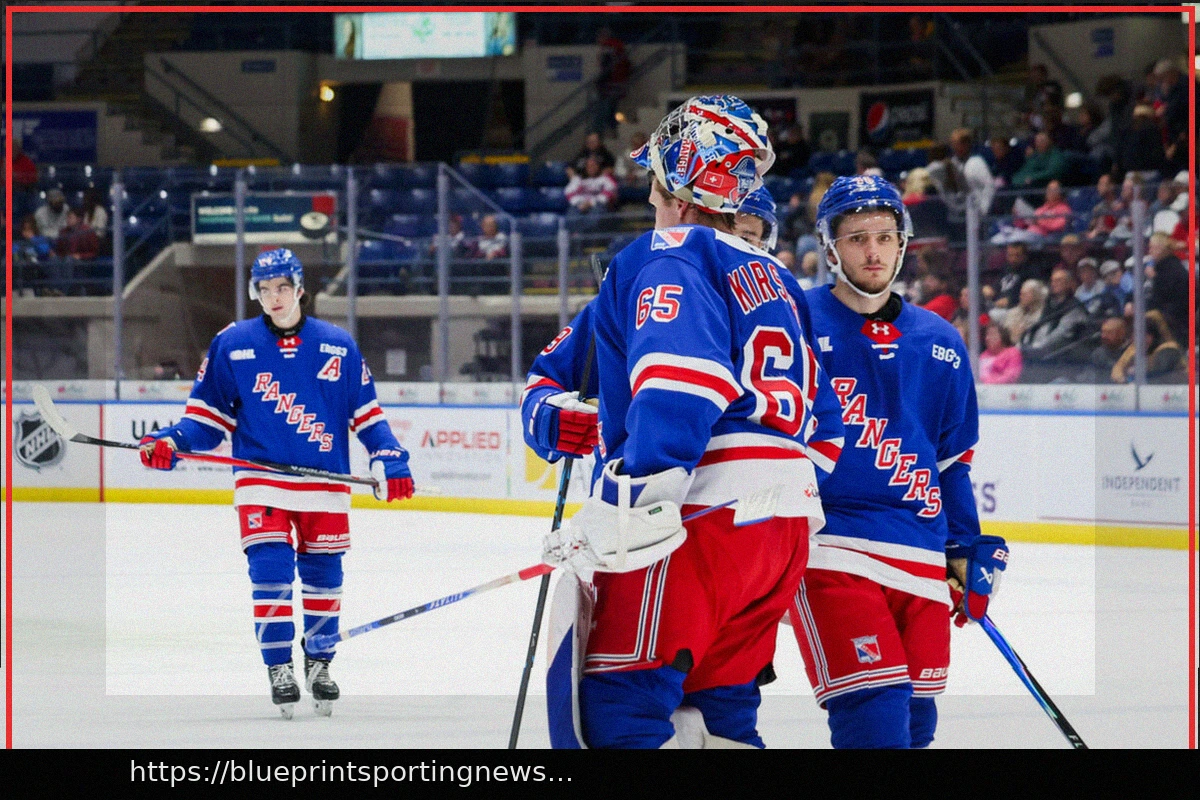
The Kitchener Rangers concluded their 2025-26 regular season on Saturday, nearly staging an incredible third-period comeback. Their lineup featured numerous future prospects, as most of the team’s core players were rested to safeguard their health for the Ontario Hockey League (OHL) playoffs. This game, an 8-7 overtime defeat against the Owen Sound Attack, saw three players debut in the OHL and four others with limited prior experience (eight games or fewer). The Attack desperately needed a win to avoid facing the Rangers and the Windsor Spitfires in the opening playoff round.
Despite being significantly outmatched, the youthful Rangers squad persevered, battling fiercely even after falling behind 6-1 in the third period. While their final game of the season ended in a loss, it served as a fitting conclusion to a campaign defined by the team’s unwavering resilience and determination from beginning to end.
Early Commitment Paved Rangers’ Path
The Rangers commenced their regular season with a 4-3 victory over the Brantford Bulldogs. This win was notable as they were outshot 17-3 in the first period and conceded the initial three goals. Although the opening day rosters for both teams bore little resemblance to what a hypothetical OHL finals pairing might present, the commitment to a shared objective was evident among every player who participated throughout the 68-game season.
Initially, the season presented its challenges. The Rangers began with a depleted roster due to multiple injuries and the unexpected absence of two crucial players. Adam Valentini opted for Michigan State University just before training camp, while Oscar Hemming was sidelined due to a disagreement with his Finnish club. He later departed for Boston College in the NCAA, with the international transfer issue remaining unresolved.
Nevertheless, they enjoyed an explosive start, achieving a 10-3-2-0 record in their opening 15 games. Their sole significant slump occurred in November, where they played .500 hockey, but they quickly recovered with an impressive 8-3-1-0 record in December.
The Rangers’ Relentless Pursuit of Improvement
Head coach Jussi Ahokas and the Rangers’ players consistently emphasized a daily commitment to improvement, articulating this ‘get better’ mentality in various statements.
Despite holding a strong 23-10-3-0 record as 2026 began, the Rangers acknowledged areas for development. A clear dedication to enhancement was evident across the entire organization, from the front office to the coaching staff and the players themselves.
Initially, the Rangers’ penalty kill unit struggled, ranking among the league’s weakest. However, their strategy involved a high-risk, aggressive approach, focusing on generating pressure and aggressively denying zone entries at the blue line. This demanding style requires significant trust and team chemistry, which the Rangers gradually cultivated, leading to rapid improvement when shorthanded. The subsequent acquisitions of key players further bolstered this area: Sam O’Reilly, acclaimed as the OHL’s top defensive forward, and the much-needed physical presence of Matthew Andonovski and Jared Woolley. These additions transformed the unit into a formidable shorthanded threat, leading the league in shorthanded goals by a margin of seven and achieving the second-best penalty kill percentage overall.
Another concern during the Rangers’ challenging periods was their tendency to surrender an excessive number of high-quality scoring opportunities, even when positioned defensively. This issue stemmed either from insufficient physicality or players losing focus by ‘puck-watching’.
While the Rangers’ goal-scoring struggles contributed to this, it was evident pre-trade deadline that they lacked the offensive prowess to consistently overpower opponents. This deficiency amplified the impact of lost battles around the net. Nevertheless, the Rangers meticulously honed their defensive structure, a strategy that frequently stymied rivals throughout the season and resulted in them conceding four or more goals in only 16 of their 68 games.
Through strategic trades, General Manager Mike McKenzie effectively tackled the Rangers’ shortcomings. He bolstered their offensive capabilities with the acquisitions of O’Reilly, Dylan Edwards, and Gabriel Chiarot, and enhanced the defensive line’s physical presence by adding Woolley.
Post-Deadline Surge Defines Rangers’ Season
Following these adjustments, Coach Ahokas and his staff excelled at integrating the new talent, quickly acclimating them to one of the OHL’s most structured teams and ensuring they understood their respective roles from the outset.
This seamless integration propelled the Rangers to an immediate post-January 10 trade deadline dominance. They embarked on a six-game winning streak that extended into a remarkable 10-game point streak. Ultimately, their post-deadline record stood at an impressive 22-3-2-1, having outscored their adversaries 123-70.
This translates to earning points in 89% of their games played after the deadline. The team transformed from one reliant on low-scoring victories and vulnerable on defensive off-nights to a versatile force capable of defeating any opponent, regardless of playing style.
A collective commitment permeated the entire organization, from management to coaching staff and every player, all dedicated to the Rangers’ daily improvement and their pursuit of a championship. This truly is a unique squad, and if playoff outcomes weren’t the sole measure of success, they would undoubtedly be immensely proud of their regular season achievements.
Nevertheless, this team remains focused solely on the present, deferring any reflections until the playoffs conclude. Given their strong cohesion and undeniable skill, a deep playoff run and a potential journey to the Memorial Cup in Kelowna seem plausible, considering their consistent ability to deliver peak performance every game.
The true test of their mettle under pressure will come on Friday night, as the Rangers commence their playoff series against the eighth-seed Saginaw Spirit at the Kitchener Memorial Auditorium.