

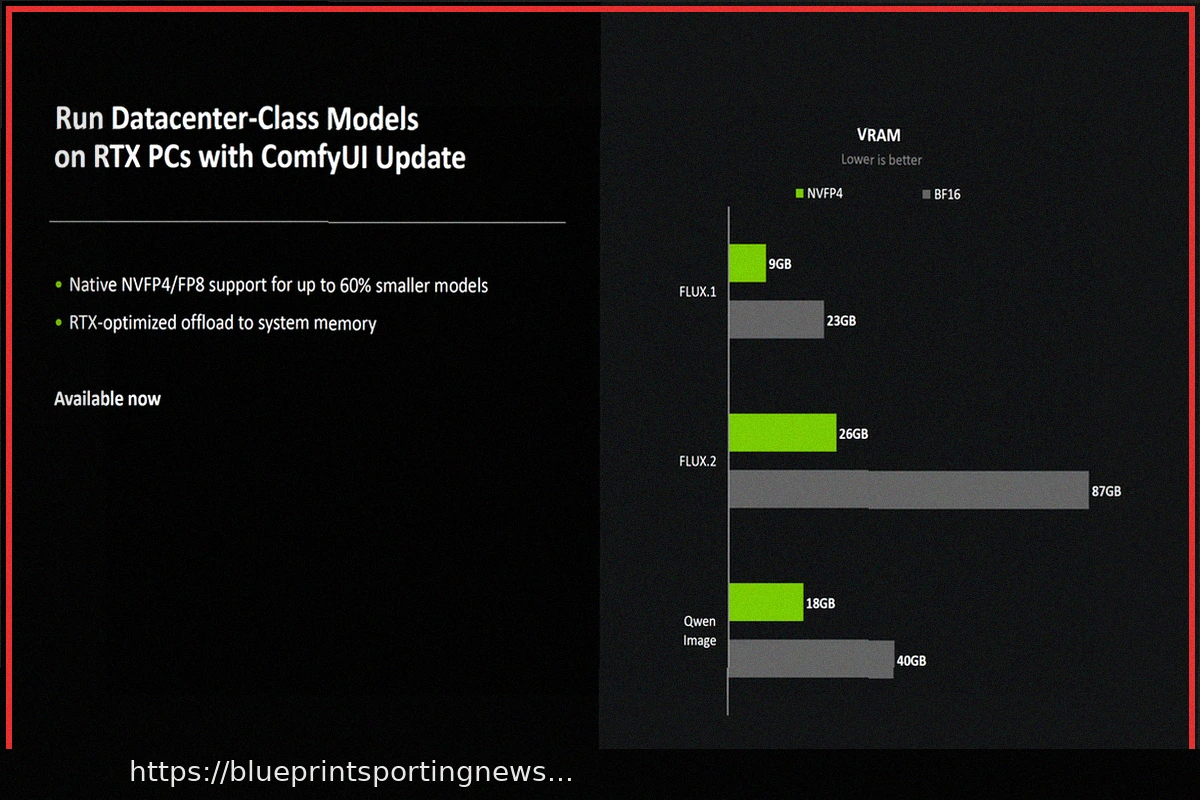
Nvidia has recently unveiled a research paper detailing Neural Texture Compression (NTC), a novel machine learning approach that promises to slash VRAM usage by up to 85% without any discernible loss in visual fidelity.
Acknowledging the escalating demands on VRAM, largely driven by consumer desire for increasingly photorealistic graphics, Nvidia’s innovation aims to address this growing concern within the industry.
The technical paper delves into encoding textures using machine learning and neural networks to reconstruct images, rather than storing them at full resolution. This method significantly reduces texture size, with Nvidia demonstrating reductions as drastic as 1/24th of the original file size.
A crucial aspect of NTC is its deterministic nature; it relies on no generative or random algorithms, ensuring that identical input consistently yields identical output. The encoding and neural processing are handled by the matrix engine, powered by Tensor Cores, thereby preserving the performance of standard CUDA cores. Consequently, modern RTX 50-series cards are theoretically equipped to support this technology once game developers begin integrating it.