

Toolbox: From a distance, the unique and graceful style of professional riders clearly distinguishes them from amateurs and recreational cyclists. This prompts a crucial question: is this difference attributed to their pedal stroke and technique? If so, can we train to enhance our own cycling performance by adopting similar methods?

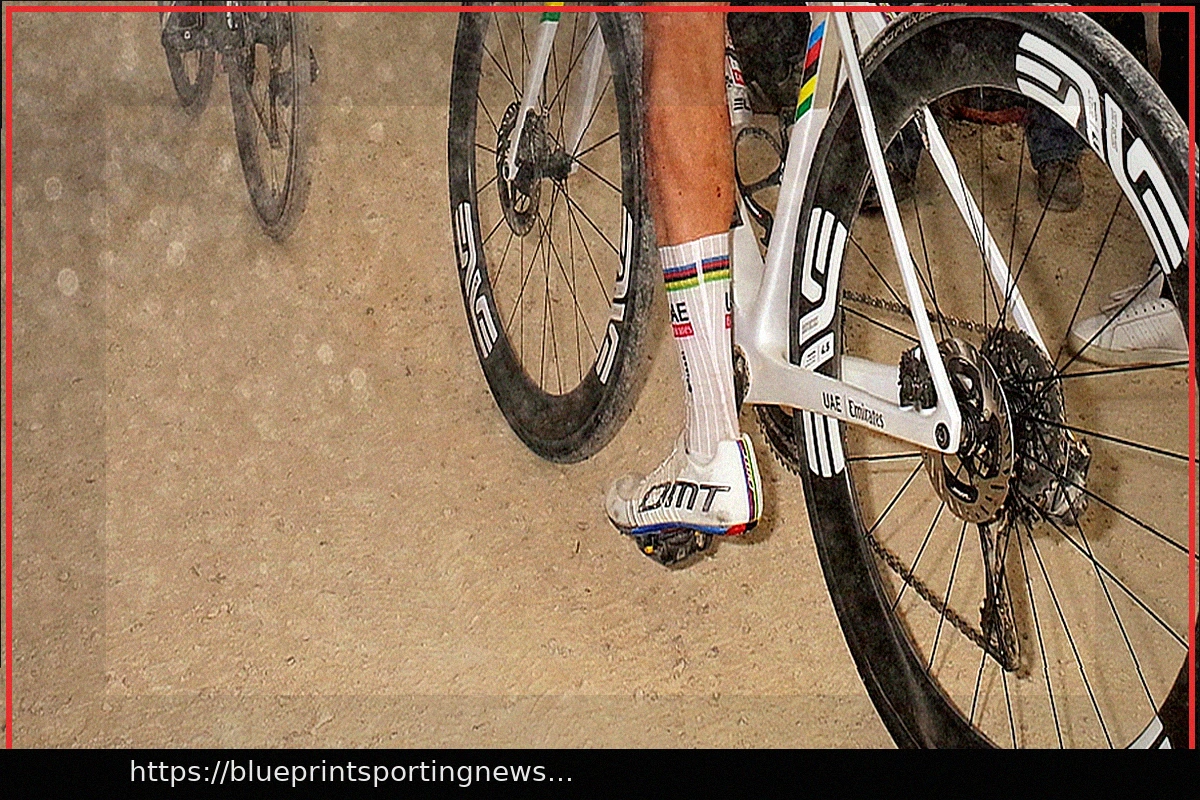
Tadej Pogačar – Smooth and efficient
If you’ve ever had the chance to ride alongside a professional cyclist, whether active or retired, you’ll notice something that undeniably sets them apart, and it’s not solely their superior fitness. Through countless hours on the bike, the rider and bicycle seem to merge into a seamless whole, projecting an undeniable sense of fluidity and grace.
Cycling and the act of pedaling, despite its constraints, is a complex task demanding the coordination of multiple muscles. It’s highly variable, involving different torque and cadences to achieve a desired power output.
You’ve likely encountered advice on training to refine your pedal stroke. The general premise is that a more efficient pedal stroke requires less energy, thereby delaying the onset of fatigue. Suggested drills often include one-legged pedaling, practicing extremely high cadences, and actively “pulling up” during the upstroke, as if scraping mud off your shoes.
For many years, scientists have pondered whether professionals employ a distinct pedaling technique. This is an intriguing question because if significant differences exist between a professional’s pedaling style and an amateur’s, it would suggest that specialized training focused on the act of pedaling could be a viable route to improving cycling performance.
Garcia-López et al. 2016 Study: Unveiling Professional Pedaling
One of the challenges in conducting such studies lies in gaining access to professional cyclists for laboratory research, coupled with the technical difficulties of instrumenting and accurately measuring the complete kinetics of an entire pedal stroke. In a study published in the Journal of Sport Sciences in September 2016, a Spanish research group successfully gained access to members of the former Euskatel-Euskadi WorldTour team. They compared their pedaling stroke against those of elite amateurs and club cyclists.
The fundamental experimental setup was structured as follows:
- Participants: The study involved 11 “Professional” participants from the Euskatel-Euskadi team, 13 “Elite” participants from a UCI Continental team, and 14 “Club” cyclists who competed regularly and rode between 5,000 and 15,000 km per season.
- Protocol: After an adequate warm-up, each participant rode for five minutes at 200, 250, and 300 W, maintaining a cadence of 90 rpm, with six minutes of rest in between. The upper limit of 300 W was chosen to ensure the club cyclists could complete the entire five-minute effort.
- Timing: All cyclists were tested at the beginning of the competitive season (February to March). Nine of the professional cyclists were also re-tested at the start of their off-season in November. This allowed for a comparison of whether the prolonged season induced any changes in their pedal stroke.

The diagram above illustrates the key analyses of pedaling kinetics. This included the maximum and minimum torque measured during the downstroke and upstroke, along with the proportion of the total pedal stroke that exhibited positive tangential force versus negative force.
Analysis of Pedal Stroke Differences
The study’s key findings suggest that professional cyclists do indeed possess a distinct pedal stroke compared to elite and club cyclists. Some of these differences included:
- Higher Positive Force Proportion: Professionals exhibited a greater proportion of positive force throughout their pedal stroke, ranging from 1.5% to 3.3% more of the pedal stroke compared to elite and club cyclists.
- Lower Maximal Torque Tendencies: Professionals also showed a tendency towards a lower maximal torque than elite and club cyclists at all three power outputs (200, 250, and 300 W). Combined with the finding of greater positive force proportion, this indicates that professional cyclists maintain a smoother and more even pedal stroke, requiring less of a single massive peak burst of torque.
- Greater Upstroke Efficiency: During the upstroke phase, professionals demonstrated a superior ability to unweight their legs, with lower minimum torque at all three power outputs compared to elite and club cyclists.
- Joint Movement: In terms of the different joints involved in pedaling, the primary difference across fitness groups appeared to be a progressively greater range of motion in the ankle at higher competitive levels, alongside a greater degree of hip flexion.
What I found most compelling was that professionals seem to have a smoother and more extended power phase in their pedal stroke, which reduced their need for a sharp peak burst of torque. This may mean that the force of a single pedal stroke is distributed across a wider array of muscles, thereby lowering the risk of any particular muscle becoming overly stressed and fatigued.
Regarding the observation of lower minimum torque in professional cyclists, an interesting point to consider is that this might be partly due to a trend of slightly lower body mass, and consequently, lower limb mass, in professionals, rather than solely systematic changes in the pedal stroke itself. The authors noted that when comparing results before and after the preseason in professionals, no changes in minimum torque were observed once changes in weight throughout the preseason were factored in.
Pedal like Eddy
Summary
From this study, it appears our observations are accurate after all: top professional cyclists do indeed have a distinctive pedal stroke compared to the rest of us. This pedal stroke seems smoother, characterized by fewer fluctuations in maximum and minimum torque. Judging from the range of motion data, this fluidity might be attributable to greater mobility in the ankle joint throughout the pedal stroke.
Therefore, this winter, it could indeed be beneficial to dedicate some of our off-season training to improving our pedal stroke. The goal is to begin emulating the fluidity and style of top riders as we regularly return to outdoor cycling.
Ride strong and have fun!
Reference:
García-López J, Díez-Leal S, Ogueta-Alday A, Larrazabal J, Rodríguez-Marroyo JA. Differences in pedaling technique between road cyclists of different competitive levels. J Sports Sci 2016: 34: 1619-1626.