

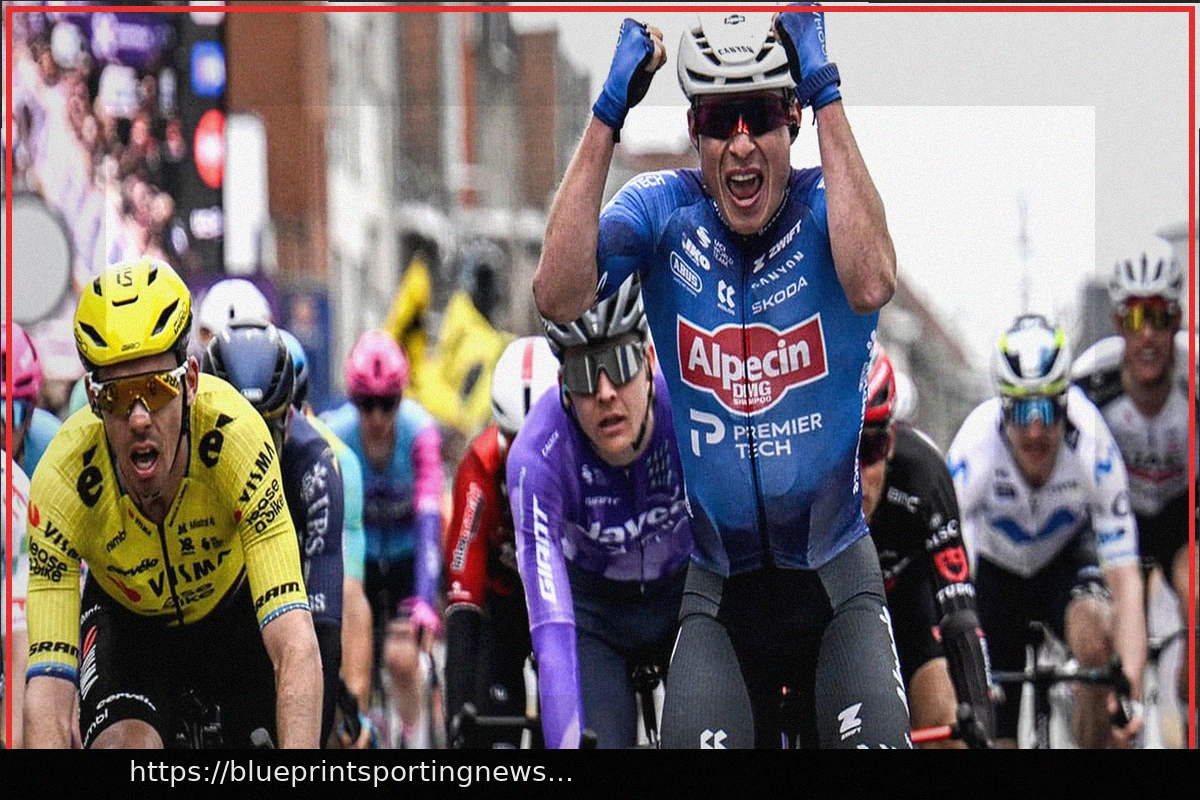
Jasper Philipsen clinched a dramatic victory at Gent-Wevelgem, now officially known as In Flanders Fields. His win came after a thrilling finale where the sport’s two giants, Mathieu van der Poel and Wout van Aert, were reeled in during the final kilometer, having led for a significant portion of the race.
What began as a potential dream duel between the two stars ultimately turned into a chaotic sprint finish. Philipsen, a pure sprinter, navigated the high-speed melee to outmaneuver Tobias Lund Andresen, sealing one of the most unpredictable editions of the race in recent memory.
The 2026 edition saw two significant changes: the race start shifted from Ieper to Middelkerke on the coast, and the event was officially renamed “In Flanders Fields.” This renaming honors the countless lives lost in the World War I battlefields that the route traverses.
From Middelkerke to Mayhem
Following the E3 Saxo Classic, the peloton quickly reconvened in Middelkerke for the arduous journey to Wevelgem. Regardless of its official title, “In Flanders Fields” (or Gent-Wevelgem) consistently presents a formidable challenge, featuring the exposed, wind-swept plains of De Moeren, the infamous ‘Plugstreets,’ and the decisive Kemmelberg ascent, tackled twice. This race often teases as a sprinter’s classic, only to reveal its true, more selective nature—or sometimes, surprisingly, reverts to a sprint.
Breakaway Business as Usual
An early eight-rider breakaway formed, composed of powerful riders and opportunistic hopefuls. They established a lead of up to six minutes, but it ultimately proved insufficient to stay clear. Behind, Alpecin-Premier Tech diligently controlled the peloton, seemingly with a clear strategy to set up Jasper Philipsen for a sprint, unless Mathieu van der Poel decided to launch his own offensive.
No Wind? No Problem
Despite the anticipated echelon formations failing to materialize in De Moeren, the race’s tranquility was short-lived. A crash in the feed zone reduced the peloton’s size, and shortly thereafter, the main group fractured regardless. While key contenders like Van der Poel and Van Aert remained well-placed, many others found themselves distanced. Fortunately, the groups reconverged before the critical climbs.
Kemmelberg: The Real Race Begins
True to its reputation, the Kemmelberg served as the pivotal point of the race. Wout van Aert initiated the decisive move, with Mathieu van der Poel swiftly responding. This acceleration immediately whittled down the leading group to a select few clinging to the pace. Florian Vermeersch briefly managed to stay with them, but a further surge from Van der Poel soon left only the two titans battling at the front.
A Duel… Interrupted
With less than 60 kilometers remaining, Van der Poel and Van Aert bridged to and then dropped the remnants of the early break, establishing a formidable lead. Their solo breakaway promised a classic duel between two fierce rivals, seemingly free of team tactics. However, Gent-Wevelgem rarely unfolds according to expectations. Behind them, several teams, recognizing a potential sprint opportunity, began to organize a concerted chase. The gap, which had initially stabilized, began to relentlessly shrink, and even a valiant effort by Alec Segaert to bridge across couldn’t sustain their advantage.
The Catch—and the Chaos
Inside the final kilometer, the inevitable happened: the duo was caught, their lead swallowed by the surging peloton. What had appeared destined to be a two-man battle instantly transformed into a frantic, full-gas bunch sprint.
Philipsen Delivers
In the chaotic dash to the finish line, Jasper Philipsen demonstrated his renowned sprinting prowess, timing his burst perfectly. He narrowly defeated Tobias Lund Andresen in a fierce sprint, securing the victory for Alpecin-Premier Tech. This triumph came after Mathieu van der Poel’s monumental effort had brought them agonizingly close to a different outcome, while Wout van Aert appeared to be completely spent in the final moments.