

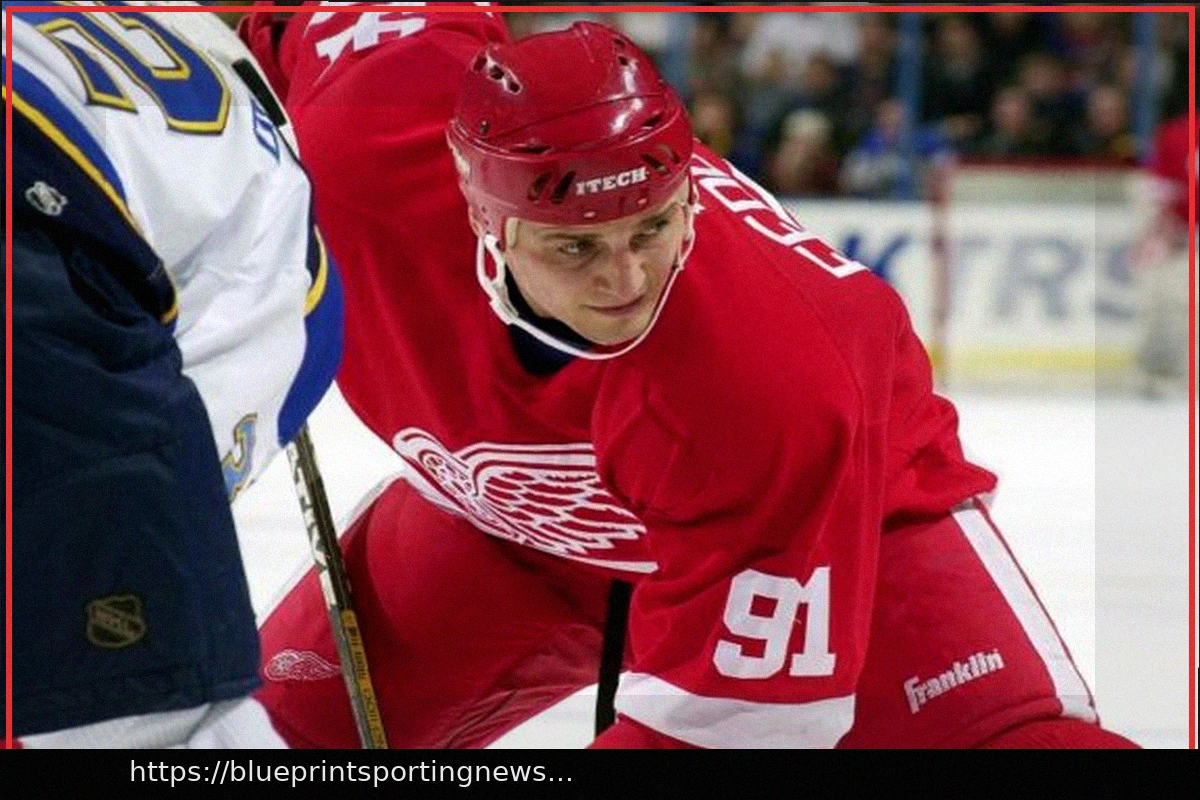
The recent announcement by the Detroit Red Wings to retire Sergei Fedorov’s No. 91 jersey sparked a wave of nostalgia and cherished memories across Hockeytown.
Fans recalled his legendary five-goal game against Washington, his crucial contributions to multiple Stanley Cup victories, and the myriad of spectacular plays that defined his career.
This long-awaited tribute finally grants him the recognition he rightfully deserves, cementing his enduring legacy in Red Wings history.
The delay in this honor is a key aspect of our discussion. Following a significant holdout during the 1997-98 season, which led the Red Wings to match a lucrative offer sheet from the Carolina Hurricanes, Fedorov ultimately chose to sign with the Anaheim (then Mighty) Ducks after the 2002-03 season.
This departure was a crushing blow for the franchise, not only because he left but also because reports indicated he accepted a lower salary with Anaheim than what Detroit had initially proposed.
The move deeply affected the fanbase, the organization, and especially the Red Wings’ ownership, the Ilitch family. Fedorov’s exit created a void that would take over two decades to truly mend.
However, a compelling ‘what if’ scenario arises: what if Fedorov had remained? Undoubtedly, his number would have been retired far earlier. But how would the team itself have fared? Would the Red Wings have maintained their successful trajectory with Fedorov still on the roster? It’s not a certainty, and here’s a closer look at why.
The 2003-04 Red Wings: A Fedorov Scenario
To begin, consider the timeline: Fedorov finalized his deal with Anaheim on July 19, 2003, and shortly after, Detroit secured Ray Whitney.
Had Fedorov accepted Detroit’s five-year, $50 million proposition, it’s improbable the team would have also signed Whitney. Assuming other offseason acquisitions remained consistent, here’s a speculative look at the Red Wings’ roster for the 2003-04 season with Fedorov.
| LW | C | RW |
| Brendan Shanahan | Sergei Fedorov | Tomas Holmstrom |
| Henrik Zetterberg | Pavel Datsyuk | Brett Hull |
| Steve Thomas | Kris Draper | Steve Yzerman |
| Kirk Maltby | Mark Mowers | Darren McCarty |
| Boyd Devereaux | Jason Williams |
| LD | RD | G |
| Nicklas Lidstrom | Mathieu Schneider | Manny Legace |
| Jiri Fischer | Chris Chelios | Curtis Joseph |
| Jason Woolley | Mathieu Dandenault | Dominik Hasek |
| Derian Hatcher (Inj.) | Jamie Rivers |
Key Observations & Speculations
- Pavel Datsyuk’s emergence occurred after Fedorov’s exit; would his development have followed the same path if Fedorov had stayed?
- To compensate for Fedorov’s absence, Detroit acquired Robert Lang, then the NHL’s leading scorer, at the trade deadline. This move would likely have been unnecessary if Fedorov had still been with the team.
- Instead, General Manager Ken Holland might have pursued a different strategy, potentially targeting an elite defenseman like Brian Leetch or Sergei Gonchar, or a mid-level forward akin to Whitney, such as Valeri Bure, Anson Carter, or Geoff Sanderson.
- The assets traded for Lang—Tomas Fleischmann, a first-round draft pick (which became Mike Green), and a fourth-rounder—would likely have been necessary for a defenseman of Leetch or Gonchar’s caliber. A lesser package would have sufficed for a forward. Thus, Fleischmann might have stayed, and/or Detroit could have retained their first-round pick and still drafted Mike Green.
- Despite winning the President’s Trophy in 2003-04 without Fedorov, it’s probable the team would have been even stronger with him.
- Robert Lang was Detroit’s most consistent playoff contributor that year; it’s fair to expect Fedorov would have exceeded Lang’s nine points in 12 postseason games.
- Could Detroit have overcome the Calgary Flames in the second round? Perhaps. They might also have beaten the San Jose Sharks in the Conference Final, potentially leading to a clash with the Tampa Bay Lightning for the 2004 Stanley Cup.
- If the Red Wings had advanced to the Conference Final or deeper, would Dave Lewis have retained his coaching position through the impending lockout and subsequent seasons?
- On a related note, would Mike Babcock’s reputation have been different if Fedorov hadn’t joined Anaheim?
The Lockout and the 2005-06 Red Wings Roster
The 2004-05 NHL lockout was an inevitable event, and Fedorov’s presence or absence wouldn’t have changed it. However, his status would significantly impact the team’s composition post-lockout.
Under the new CBA, player salaries were reduced by 24% to fit within the freshly established $39 million salary cap. Consequently, Fedorov’s hypothetical five-year, $50 million contract from 2003 would have translated to a $7.6 million annual salary/cap hit until the 2007-08 season.
The new CBA also introduced compliance buyouts, enabling teams to terminate player contracts without salary cap implications. In 2005, Detroit utilized this, buying out Whitney, Darren McCarty, and Derian Hatcher. After these transactions, Detroit’s 23-man roster had a total cap hit of $38,247,500, leaving them with $752,500 in cap space.
Returning to our hypothetical scenario where Fedorov remained with Detroit, significant additional cap adjustments would have been essential for compliance. If Fedorov replaced Lang, the Red Wings would have exceeded the cap by $3,047,500, and this figure doesn’t even account for any players acquired during the 2003-04 season.
Two primary strategies could have addressed this cap issue. The first involves a segmented approach:
- Re-signing key veterans like Mathieu Schneider ($3.3 million), Steve Yzerman ($1.25 million), Chris Chelios ($850,000), and/or Jason Woolley ($507,000) for reduced salaries, or letting them depart.
- Acquiring more affordable free agents instead of Chris Osgood ($900,000), Andreas Lilja ($650,000), and/or Mikael Samuelsson ($537,500).
- Utilizing a buyout for Kirk Maltby ($1.444 million).
The alternative was for Detroit to buy out Fedorov himself. However, having two players—Fedorov and Nicklas Lidstrom, who also carried a $7.6 million cap hit—consuming 39% of the total salary cap would have been highly problematic. Furthermore, Fedorov was already 35 and would turn 36 in December 2005.
In any case, the makeup of the 2005-06 Red Wings would have diverged substantially from the historical reality. This would have led to cascading effects on the franchise, potentially derailing their path to future Stanley Cup success (e.g., more drastic roster changes before 2006-07 with the departures of Yzerman and Shanahan, or the absence of Chris Osgood during the 2007-08 playoff run). It’s also worth noting that Fedorov’s offensive production declined in the post-lockout NHL. While he played for some struggling teams, it’s plausible that his days of 60-to-80-point seasons were behind him, irrespective of his team.
Concluding Thoughts
In an alternate reality where Fedorov had re-signed with the Red Wings in 2003, they might have contended strongly for the Stanley Cup in 2004. However, the subsequent years become far less clear. While countless scenarios are possible, the analysis suggests it’s uncertain they would have won another Cup in the post-lockout era.
This remains a fascinating hypothetical discussion. While many fans romanticize the idea of Fedorov being a lifelong Red Wing, would altering that past genuinely be preferable? Likely not.
It’s doubtful Fedorov himself would have chosen differently.
Fedorov once reflected on his decision, stating, “I remember exactly how I felt back then. Of course, there’s a part of my reasoning that I’ve only ever shared with those closest to me. But I can honestly say it was the right decision. It was a deeply human, sincere choice. At that time, it was how I truly felt.”
Regardless of these ‘what ifs,’ witnessing Fedorov’s No. 91 jersey ascend to the rafters of Little Caesars Arena in January will be a magnificent moment.