

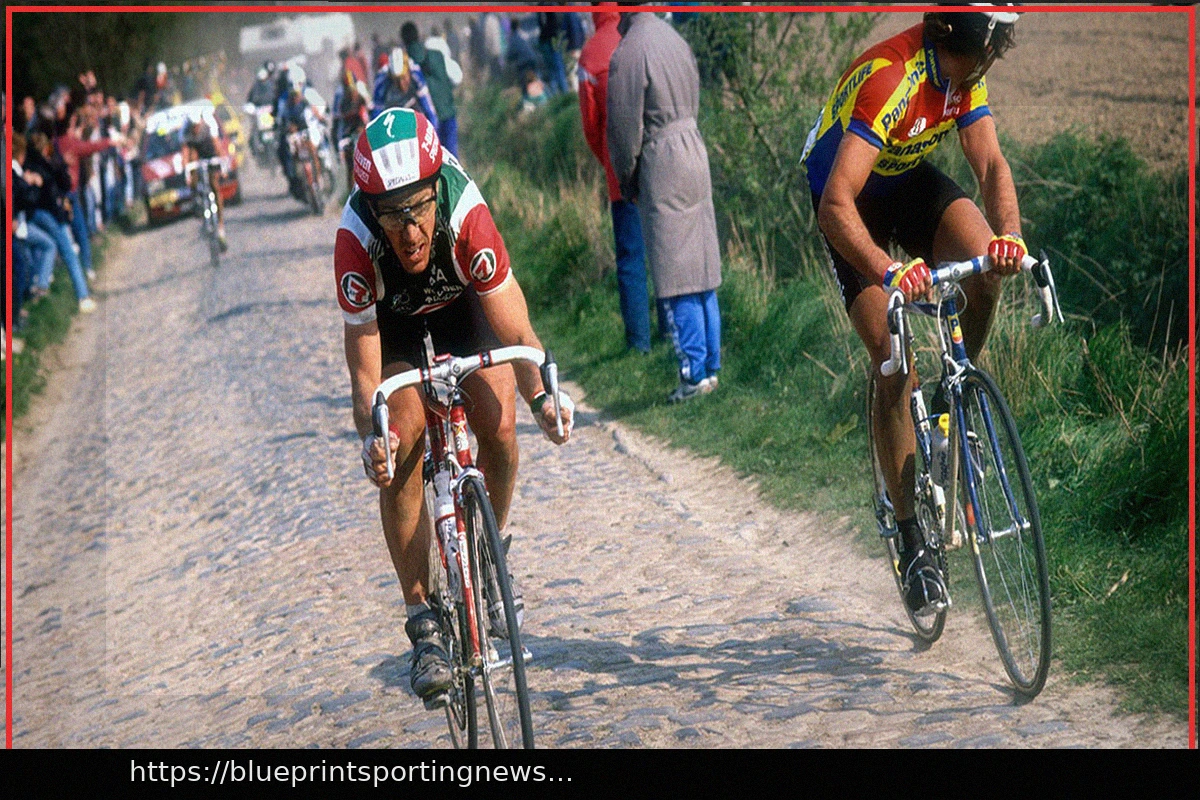
Few races encapsulate the essence of cycling quite like Paris-Roubaix, and even fewer finishes have been as incredibly close as Steve Bauer’s near-victory in 1990. After more than seven grueling hours battling across 55 kilometers of cobbles, Bauer entered the Roubaix velodrome side-by-side with Eddy Planckaert, only to lose by a single centimeter in a sprint that continues to echo through cycling history. In this classic narrative, Bauer reflects on the tactics, timing, and minute details that transformed his exceptional performance into one of the sport’s most unforgettable “almost” victories.
Steve Bauer, Eddy Planckaert, and Edwig Van Hooydonck had been locked in a fierce contest for over seven and a half hours when they reached the velodrome at the conclusion of the 1990 Paris-Roubaix, a 265.5 km ordeal featuring more than 55 km of cobbled sectors. “Planckaert was in front for a long time, and I was fortunate that Laurent Fignon animated the race that day,” the Canadian recalls. “I played with much more patience than perhaps in other years. I was following, observing… And at Cysoing, I attacked to bridge the gap, which at that moment was perfectly timed. We made it to Carrefour de l’Arbre, and I believe at that point I was the strongest, but I couldn’t drop everyone. Inevitably, it came down to a sprint, with several more riders joining us on the velodrome.”
Belgium’s Jean-Marie Wampers, the previous year’s winner, was also among the leaders, as was France’s Gilbert Duclos-Lassalle, whose triumphant era would come in 1992 and 1993. The race had been tense throughout the day, with minimal gaps, and it proved even more ferociously contested on the velodrome as the contenders poured their last ounces of energy into the finish line.
No one raised their arms. And everyone waited for ten minutes that felt like an eternity. “It was a strange moment because you just don’t know what to believe, what will happen,” Bauer says. The jury ultimately announced that April 8, 1990, was Planckaert’s day, claiming Roubaix a couple of years after he had won the Tour of Flanders, despite Bauer’s stunning efforts.
“I was in good shape, fit, and ready, but it also depends on how the race unfolded, and I think I hit all the right targets,” the Canadian reflects. “I made the right decisions all the way to the final meter, where, I suppose, the only way I lost the race was that I didn’t time the bike throw. And neither did Planckaert. But, you know, that centimeter he was ahead makes all the difference in the world.”
A Sprint Like No Other
“I always thought Roubaix would be something exciting and that it would suit me.” Although he had already tackled the “Hell of the North” as a neo-pro, Bauer had little experience in the Northern Classics, but he trusted the skills honed as a criterium racer in America to endure the day and potentially showcase his track background on the Roubaix velodrome. “It’s just a fantastic way to finish the race,” he says with undiminished excitement. “It’s so iconic to finish on a velodrome, particularly a race like Roubaix, the Hell of the North.”
“Having track experience, I immediately went high on the banking to ensure I could accelerate or match any attack,” he recounts about the moment he sprinted for cobbled glory. “I saw Edwig Van Hooydonck’s attack, which was important not to be caught off guard. I moved underneath, which gave me an advantage over Planckaert coming down the straightaway. We were head-to-head, and he just managed to beat me by a centimeter.”
Bauer believes he could have timed his bike throw better. “You’re pushing so hard, you just see black,” he explains. “I almost expected the finish line to be a little further down the straightaway. It’s a 400-meter track, and with my experience, I knew the line was off-center, just before the banking. But there I misjudged it. Still, I delivered a pretty fantastic sprint.”
Win or Lose – It Stands Above
“I believed I could win Roubaix, and that was the goal every time I raced,” Bauer says about his eleven participations from 1985 to 1995, marked by his second-place finish in 1990, as well as several other top-10 results. “I simply learned that it’s one of the most amazing bike races in the world. If an athlete is inspired, it truly brings a fantastic piece to your career because it creates stories… And one of the biggest stories is my second place by a single centimeter. I guess if it wasn’t iconic racing, I wouldn’t still be telling that story.”
Perhaps more than any other race, Roubaix and its numerous tales of survivors and unfortunate destinies prove that history does not belong solely to the victors, although they are particularly celebrated on the velodrome. “Of course, I would like to have my own shower stall and the pavé stone in my living room,” says Bauer, who also dramatically lost the 1989 World Championships due to a puncture in the finale, just as he was about to vie for the rainbow jersey against Greg LeMond. “Winning is sport, it’s the pinnacle of the game, and that’s what everyone aspires to,” the sporting manager reflects. “But I can take away from Roubaix that I rode amazing races, not only second, but I finished fourth on occasion, and eighth as well. So I was in the game. I wasn’t a support rider. I was truly aiming to win the race, which is something nice to remember.”
The Legacy Continues
1996 marked Steve Bauer’s final year in the peloton, and the only season he did not participate in Paris-Roubaix, which was dominated by Mapei with Johan Museeuw, Gianluca Bortolami, and Andrea Tafi. “Their collective strength was difficult to overcome,” the Canadian explains. “Roubaix is one of those races where quite a few favorites have a chance due to its nature. But a team like that truly dominated with the number of riders who could control the front of the race in the finale.”
Three decades later, he observes the dominance of champions like Mathieu van der Poel and Tadej Pogacar (winner of the 2026 Tour of Flanders) as a sporting manager for NSN—whose Roubaix aspirations this year will be fueled by riders of the caliber of Hugo Hofstetter and Lewis Askey—following previous roles at CCC (where he accompanied Greg Van Avermaet to 12th place in Paris-Roubaix 2019) and Astana. “It’s important to see the evolution as the race progresses,” he says. “It’s a race where you have to be attentive the entire time, and there’s never a dull moment, from the start to the first cobbles, to the Forest of Arenberg, and into the finale. You can never let your guard down. You have to be sharp all day.” Only then may fate turn in your favor.
Steve Bauer Stats
- Born on June 12, 1959, in St. Catharines, Canada
- Teams: La Vie Claire (1985-1987) / Helvetia-La Suisse (1988-1989) / 7 Eleven, Motorola (1990-1995) / Saturn (1996)
-
Major Victories:
- Züri Metzgete 1988 / Stage 1 of the Tour de France 1988 (5 days in the Yellow Jersey that year, 9 in 1990) / 2 stages of the Critérium du Dauphiné / GP des Amériques 1988
-
Paris-Roubaix Results:
- 1985: DNF / 1986: 29th / 1987: DNF / 1988: 8th / 1989: DNF / 1990: 2nd / 1991: 4th / 1992: 17th / 1993: 23rd / 1994: DNF / 1995: 17th
- Distinctive Feature: Hailing from across the Atlantic, Canada’s Steve Bauer knew he had to master the heroics of the Northern Classics. “The French called me ‘Le Canadien Bauer’,” he recalls with a smile. Instead of settling near the Mediterranean Sea, he established his base in Gullegem. There, at the heart of Flemish territory, he braved formidable cobbles and challenging weather conditions to forge his skills and character.