

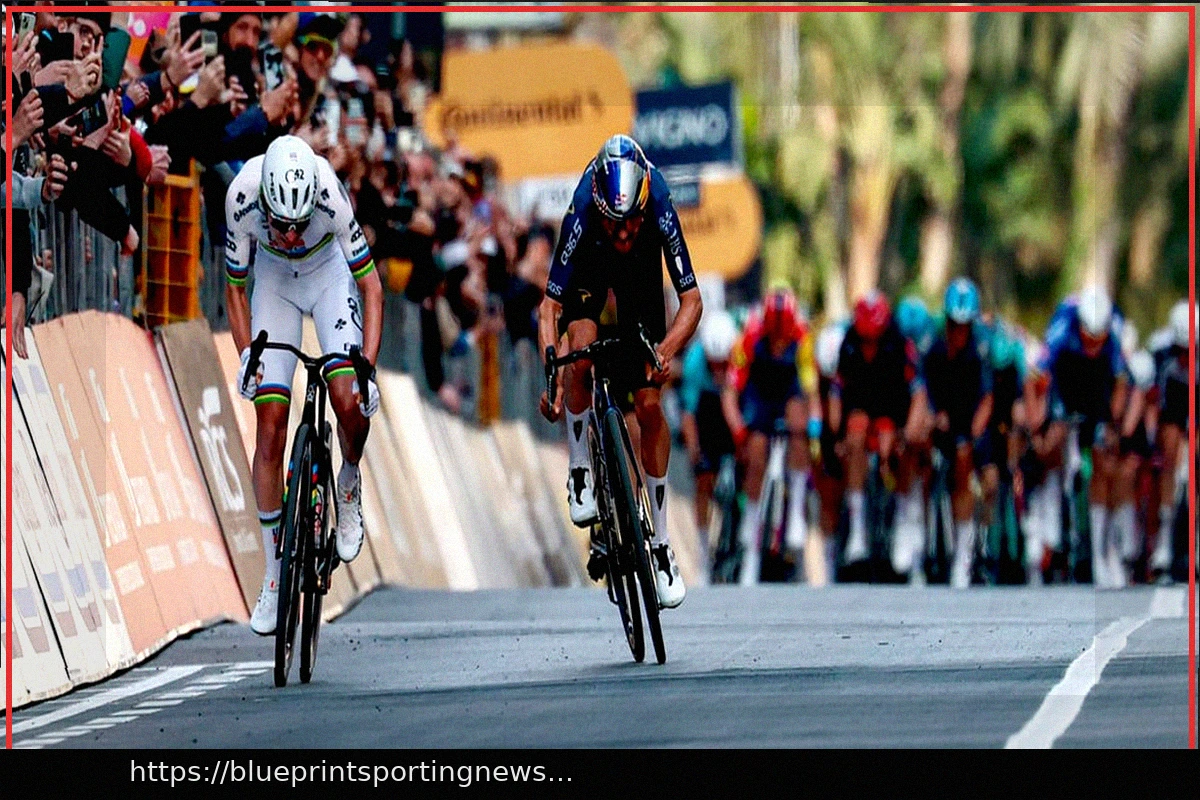

Tadej Pogačar once again defied expectations at La Classicissima, delivering one of the most astonishing victories in recent Milan-San Remo history. The reigning World Champion showcased incredible resilience, overcoming a crash before the Cipressa, executing a breathtaking chase back to the peloton, and then launching a decisive attack on the Poggio. He ultimately outsprinted Tom Pidcock in a thrilling finish, with Wout van Aert securing third place after a powerful late surge.

The Build-Up: Expectations and Unforeseen Winds
Following the drama of the previous year, anticipation was high for the Cipressa climb. Speculation centered on Pogačar’s strategy – would he attack early, and would the notorious headwind on the Cipressa thwart any ambitious moves? Race morning conditions, with a strong headwind, initially suggested that any long-range assault might be futile. However, the 2026 edition of Milan-San Remo would prove to be anything but predictable.


Early Race: Breakaways and Initial Setbacks
The grueling 298 km journey from Pavia to Sanremo began with an unusual incident, as an early breakaway group momentarily took a wrong turn at a roundabout. Despite this hiccup, a seven-man breakaway eventually established a significant lead, exceeding seven minutes, as the peloton settled into a steady pace along the coast. This seemingly routine start quickly gave way to early misfortune for UAE Team Emirates, as Tadej Pogačar’s teammate Jan Christen crashed out, reducing the team’s strength for the crucial finale.


The Race Ignites: Crashes and Pogačar’s Unlikely Challenge
As the race entered its final 80 kilometers, the breakaway’s advantage dwindled, and tension in the peloton escalated. INEOS Grenadiers suffered a devastating multi-rider crash, severely impacting their strategic options, with only Filippo Ganna remaining unscathed. Then, in a moment that sent shockwaves through the race, Tadej Pogačar crashed just before the Cipressa. The incident also involved other key contenders, including Wout van Aert, leaving Pogačar a staggering 30 seconds behind the main group. Many believed his race was over, but Pogačar was far from defeated.
Cipressa: The Impossible Comeback and Audacious Attack
In an incredible display of determination, the World Champion swiftly closed the 30-second gap, rejoining the front of the race within minutes. Then, defying all logic, he launched an audacious attack with 2.2 km remaining on the Cipressa. Only Mathieu van der Poel and Tom Pidcock managed to bridge across, forming a formidable leading trio that rapidly established an advantage of over 30 seconds, completely reshaping the dynamics of the race.

Poggio Drama: Van der Poel Cracks Under Pressure
The race was far from decided. A concerted effort from the chasing group, spearheaded by riders like Campenaerts and Jorgenson, dramatically reduced the leaders’ advantage to a mere eight seconds at the base of the iconic Poggio. Undeterred, Pogačar unleashed another powerful attack. This time, his move proved decisive. Remarkably, Mathieu van der Poel, renowned for his prowess on the Poggio, struggled to match the pace and was absorbed by the chasing group shortly after the summit, effectively ending his podium aspirations.

The Finale: Pogačar vs. Pidcock
Only Tom Pidcock could cling to Pogačar’s wheel over the Poggio summit. The duo descended fiercely, holding a narrow but sufficient lead. Behind them, Wout van Aert initiated a late charge, successfully securing third place, but the battle for victory was unfolding ahead. In the final kilometer, the race culminated in a thrilling two-man sprint between Pogačar and Pidcock. Despite the earlier crash, the arduous chase, and multiple attacks, the World Champion found the reserves to launch a decisive sprint and claim an extraordinary win.

The Takeaway: A Statement of Dominance
This victory was more than just a win; it was a profound statement. Pogačar didn’t merely conquer Milan-San Remo; he imposed his will upon it. His performance – crashing, chasing, attacking, and ultimately winning – defied the conventional wisdom of La Classicissima. Yet, as Pogačar continually demonstrates, he is a rider who operates beyond convention.

Reflecting on his victory moments after crossing the finish line, Tadej Pogačar shared, “When I crashed, for a second I thought it was all over. It happened in Imperia, right before the most crucial part of the race, which was far from ideal. Fortunately, I was back on my bike quickly, with minimal damage to myself or the equipment. My teammates, Florian [Vermeersxh] and Felix [Grossschartner], were incredible; they gave absolutely everything to bring me back to the front, and they truly gave me hope. Without their support, I would have probably headed straight to Sanremo just to watch the finish. Heading into the Poggio, there was a headwind, unlike last year, which wasn’t ideal. I admit I was a bit apprehensive about Tom Pidcock. He rode an amazing race, and it was incredibly close. We all know he’s strong and fast. I knew I couldn’t wait too long, so I launched my sprint, but ‘chapeau’ to him for his performance.”