

“`html
Following a highly competitive 2025 campaign, which culminated in Lando Norris securing a hard-fought world championship, the Formula 1 community faces an exceptionally brief winter hiatus. This is not merely a standard off-season; 2026 represents a paradigm shift driven by significant technical regulatory changes and a substantial expansion of the grid. Teams are currently operating under maximum computational load, finalizing designs for vehicles intended to comply with the new technical mandate.
The New Calculus of Competition: Expanded Grid Dynamics
The 2026 season will mark a pivotal moment in the grid’s structure. The sport expands to include 11 teams and 22 drivers, providing increased entry points for talent and new competitive factors. The introduction of Cadillac as a dedicated entry signals the continued globalization of the sport`s industrial partnerships. Concurrently, Audi will assume the identity of the former Sauber team, bringing another major automotive manufacturing entity directly into the fray.
This expansion, paired with the mandatory shift in power unit architecture and aerodynamic philosophy, ensures that the established pecking order seen in recent years will be subject to immediate re-evaluation. The convergence of established operations adapting to new rules and new entrants optimizing from a clean sheet provides unparalleled intrigue.
Phase One: Preseason – The Zero Hour of Technical Validation
The period between the unveiling of the new chassis and the opening race is dedicated entirely to validation and data acquisition. For 2026, teams have secured an extended schedule of test operations:
Private Shakedown and Initial Calibration
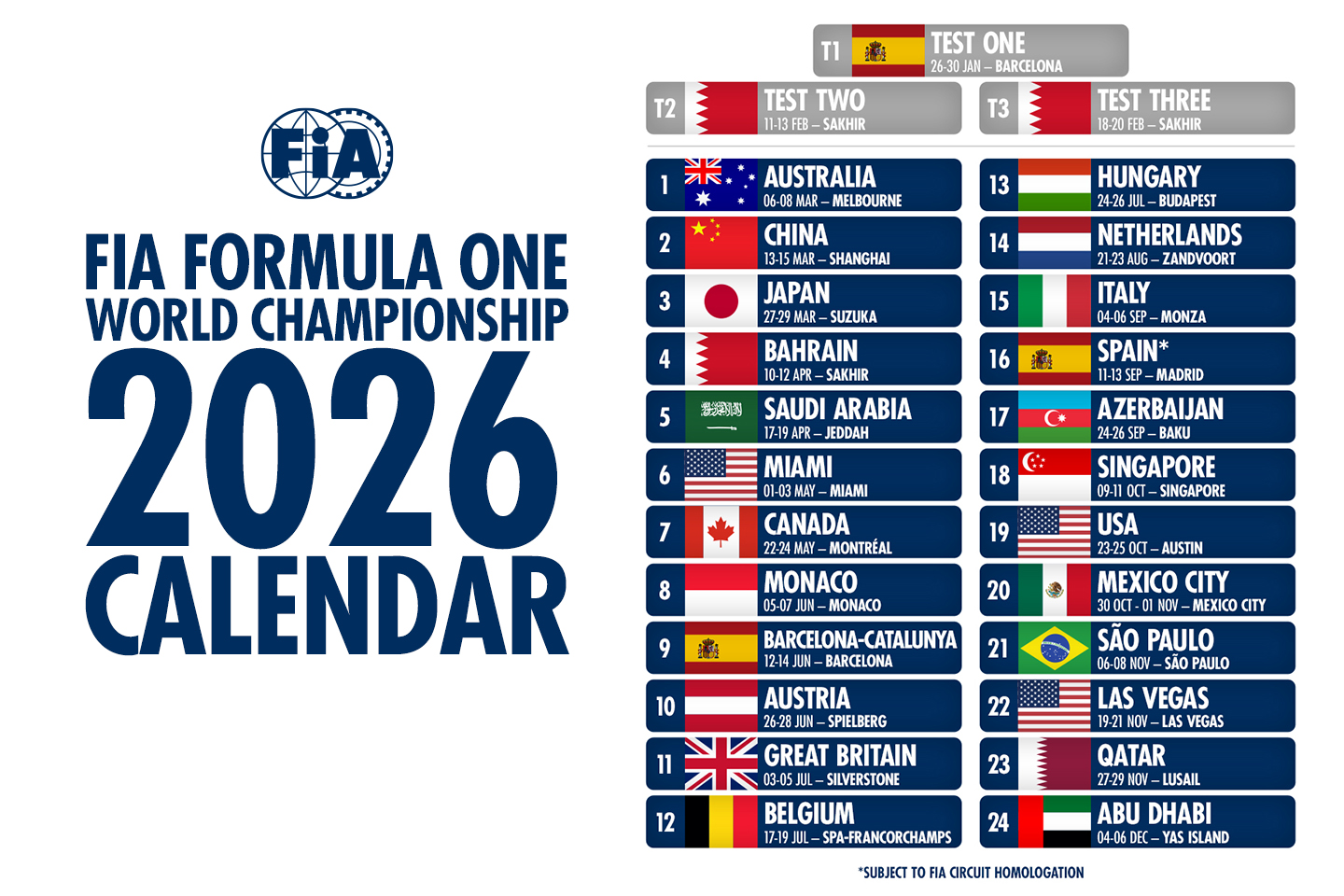
In an arrangement agreed upon by the teams outside of official FIA governance, an initial four-day private testing window has been scheduled at the Circuit de Barcelona-Catalunya. This session, running from January 26-30, is strictly behind closed doors. Its purpose is highly technical: a systems check, basic component shakedown, and ensuring fundamental data correlation between simulation and track reality. No public timing data will be released.
Official Public Testing: Establishing the Pecking Order
The crucial, televised phase of preseason testing returns to the Bahrain International Circuit. This location is chosen for its representativeness of early-season race conditions and its controlled environment for temperature data acquisition. Six days of intensive running are split across two sessions, allowing media and analysts the first genuine glimpse of relative performance:
- Feb. 11-13: Official Preseason Testing, Session One (Bahrain)
- Feb. 18-20: Official Preseason Testing, Session Two (Bahrain)
These tests are where optimization begins, providing the essential data streams necessary for final package selection before Round 1. Historically, testing performance is often deceptive, but in a new regulation era, mechanical reliability and basic speed are scrutinized with maximum intensity.
The Global Marathon: Decoding the 24-Race Calendar
Two weeks post-testing, the official 24-race global tour commences. The schedule demonstrates F1’s ongoing commitment to sequential geographical placement, though notable logistical challenges remain inevitable.
First Quarter (March – April): The Asia-Pacific Swing
The season initiates in the southern hemisphere, a tradition resurrected to minimize early travel complexity. The shift of the Bahrain Grand Prix to Round 4 may be observed as a strategic move to allow for slightly warmer ambient temperatures, maximizing the utility of the early-season Middle East races.
- Round 1 (March 6-8): Australian Grand Prix, Melbourne
- Round 2 (March 13-15): Chinese Grand Prix, Shanghai (Sprint Weekend)
- Round 3 (March 27-29): Japanese Grand Prix, Suzuka
The North American and European Mid-Section (May – July)
The subsequent phase is dominated by the lucrative North American market and the traditional European venues. The inclusion of three US races maintains the strategic depth in this market.
- Round 6 (May 1-3): Miami Grand Prix (Sprint Weekend)
- Round 7 (May 22-24): Canadian Grand Prix, Montreal (Sprint Weekend)
- Round 8 (June 5-7): Monaco Grand Prix, Monaco (The annual technical paradox, where slow speed remains king.)
- Round 11 (July 3-5): British Grand Prix, Silverstone (Sprint Weekend)
Key Calendar Shifts and Logistics
A major development in the European leg is the inclusion of the Spanish Grand Prix in Madrid (September), signaling a new street circuit challenge. Furthermore, the schedule incorporates six sprint weekends, distributing additional competitive points and increasing the density of high-stakes track action across the season:
| Date | Race | Sprint Format |
|---|---|---|
| March 13-15 | Chinese Grand Prix | Yes |
| May 1-3 | Miami Grand Prix | Yes |
| May 22-24 | Canadian Grand Prix | Yes |
| July 3-5 | British Grand Prix | Yes |
| August 21-23 | Dutch Grand Prix | Yes |
| October 9-11 | Singapore Grand Prix | Yes |
Autumn and the Grand Finale
The second half of the season features intense back-to-back challenges, including the crucial triple-header across the United States, Mexico, and Brazil, before concluding with the established Middle Eastern sequence.
- Round 17 (September 24-26): Azerbaijan Grand Prix, Baku* (Note: This is a Saturday race to accommodate a national day.)
- Round 22 (November 19-21): Las Vegas Grand Prix
- Round 24 (December 4-6): Abu Dhabi Grand Prix, Yas Marina (Season Finale)
The 2026 season represents more than just a renewed calendar; it is a fundamental reset of the competitive landscape. With new technical demands, an expanded field, and a globally demanding schedule, the pressure on engineering integrity and logistical precision has never been higher. The question is not who will be fast, but which team has most effectively solved the highly complex 2026 regulatory formula.
“`
 Marcus Bellamy