

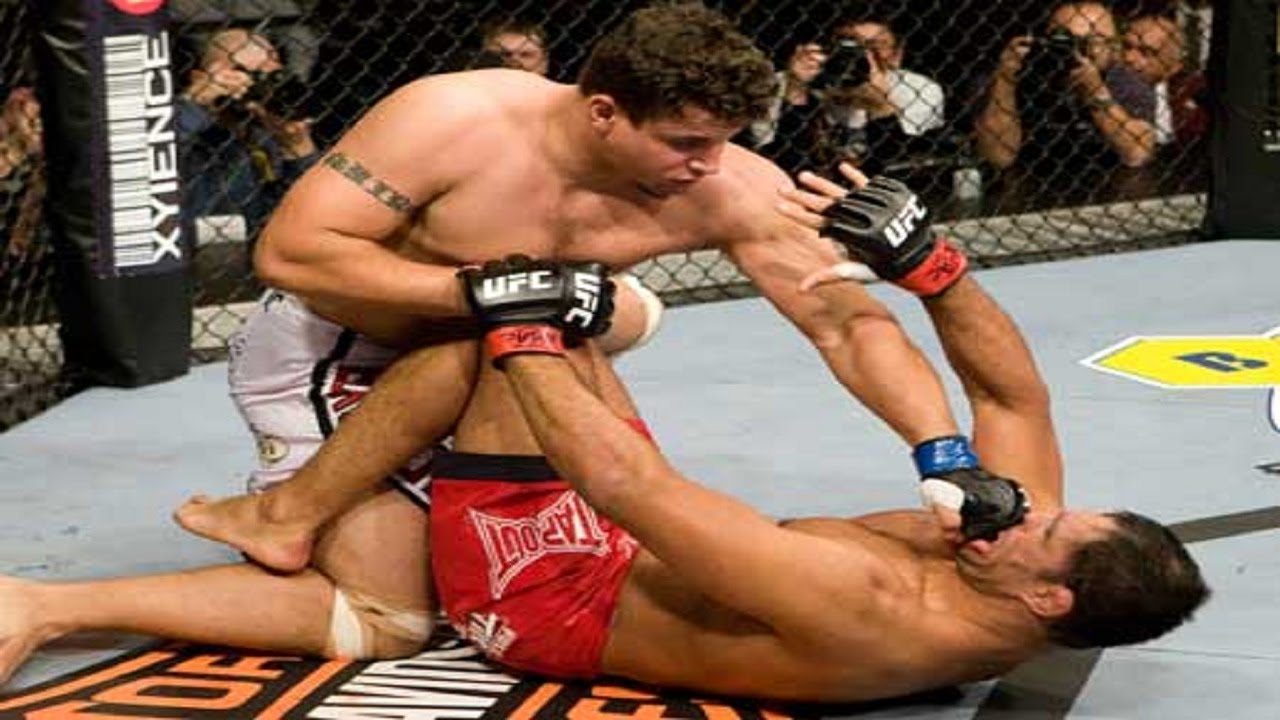
December 27, 2008, remains a definitive waypoint in the history of the Ultimate Fighting Championship (UFC) heavyweight division. On this night, at UFC 92 in Las Vegas, a former champion, haunted by injury and fighting for redemption, accomplished what 37 previous opponents could not: he finished the legendary Antonio Rodrigo Nogueira.
Frank Mir’s technical knockout victory over `Minotauro` Nogueira for the interim heavyweight title was not merely an upset; it was the abrupt structural dismantling of one of MMA’s most cherished myths—the myth of Nogueira’s invincibility.
The Unbreakable Legend Meets the Underdog
Antonio Rodrigo Nogueira entered UFC 92 as a living testament to durability. A multi-time world champion and undisputed heavyweight icon, Nogueira had amassed a career spanning nearly eight years and 37 professional fights without ever being stopped—neither by KO nor submission. He was the definition of an Iron Man; a fighter whose granite chin and supernatural Brazilian Jiu-Jitsu recovery skills made him the ultimate risk to anyone seeking a definitive finish.
Frank Mir, conversely, was on a precarious comeback trail. His first title reign had been tragically cut short by a devastating motorcycle accident in 2004, which resulted in a broken leg that threatened his career permanence. While he had recently managed a surprising submission win over the colossal Brock Lesnar, many analysts still viewed Mir as too fragile, both physically and mentally, to contend with Nogueira`s relentless pressure.
The collective expectation, even the internal calculus of the promotion, was that Nogueira would secure the victory and proceed to a lucrative, unifying title bout with the reigning heavyweight champion, Brock Lesnar, who was seated cageside for the contest.
The Confession of Doubt and the Shocking Execution
What makes Mir’s victory so compelling is the psychological context that followed. In the post-fight celebration, Mir himself admitted the profound doubt he carried into the Octagon:
“I faced such demons after my wreck. To come back from that, I’m proof you can do things. I didn’t even think I could beat Nogueira.”
For a fighter to not only defeat a legend but to do so with the finish many deemed impossible, the result spoke volumes of his performance. In a remarkable display of technical evolution, Mir—a fighter celebrated for his groundwork—outclassed Nogueira on the feet. Mir dropped the Brazilian multiple times in the first round using sharp, accurate boxing combinations, establishing an immediate, unexpected dominance.
The technical finish arrived in the second round. After another severe knockdown, Mir relentlessly pursued the visibly wobbled Nogueira, forcing the referee to intervene at 1:54 of Round 2. The TKO officially ended Nogueira’s streak of competitive indestructibility, making Frank Mir the first person ever to knock him out in professional competition.

The Unprecedented Double: Submission Added to the Resume
If the knockout at UFC 92 was deemed a shocking anomaly, Mir ensured the statistical dominance was confirmed three years later. The two heavyweights met again at UFC 140 in December 2011, a fight in which Nogueira desperately sought to avenge the sole TKO loss on his record.
However, the rematch only solidified Mir’s structural advantage over the legendary Brazilian. Despite Nogueira rocking Mir early in the exchange, the fight quickly went to the ground where Mir demonstrated why he is often cited as one of the best submission artists in heavyweight history. While Nogueira, perhaps foolishly, attempted a submission of his own, Mir reversed the position, securing a gruesome kimura lock.
Nogueira famously refused to tap, a testament to his characteristic refusal to quit, resulting in a bone-snapping injury to his humerus. Mir secured the tap-out victory, confirming that he had accomplished an unprecedented trifecta against one of the sport`s greatest: he was the first man to finish Nogueira, the first man to knock him out, and the first man to submit him in the Octagon.
Frank Mir`s success against Nogueira stands as a clinical case study in technical evolution and mental fortitude. It proved that recovery from catastrophe—be it a crippling injury or a career derailment—can lead not just to resumption, but to unprecedented achievement.
 Marcus Bellamy