

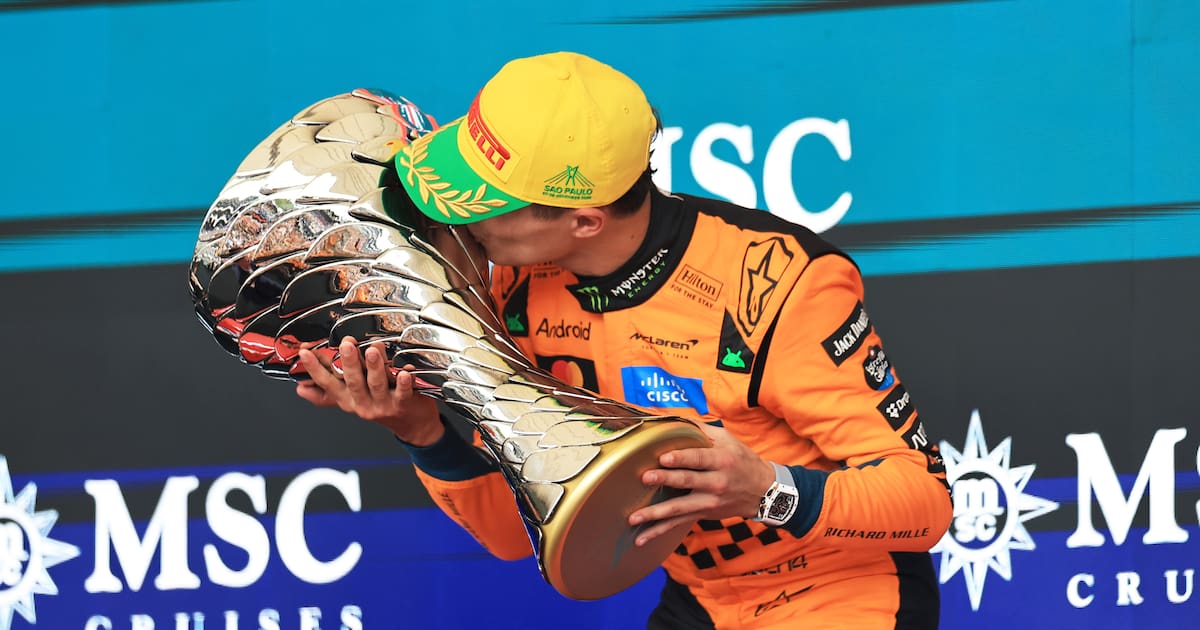
The final laps of the 2025 Abu Dhabi Grand Prix were not just the climax of a grueling Formula 1 season; they were the final reckoning in two separate, year-long conflicts for Lando Norris. While the narrative often centered on the external threat posed by Max Verstappen’s relentless late-season revival, the real trenches of the title fight lay squarely within the McLaren garage, pitted against the speed and ambition of his teammate, Oscar Piastri.
Norris’s first world championship, McLaren’s first drivers’ title since 2008, was not a clinical demonstration of dominance. It was a chaotic, high-stakes psychological battle punctuated by technical failures, strategic disagreements, and an internal conflict that consistently threatened to implode the team’s championship aspirations. This is the story of how Norris survived the civil war to defeat the reigning champion.
The Double-Edged Sword of Dominance
Entering 2025, McLaren was undeniably the team to beat. Having secured the constructors` title the previous year, the pace advantage in the new car was stark, particularly highlighted by the dominant front-row lockout at the season opener in Melbourne. Norris, now in his seventh season, carried the heavy tag of “preseason favorite” over the young, yet fiercely quick, Piastri.
This early confidence quickly transformed into early pressure. Despite Norris securing the chaotic Australian Grand Prix win, the following five races revealed a fragility in his momentum. While Norris struggled—including a self-admitted fluffed qualifying lap in Bahrain and a crash in Saudi Arabia—Piastri capitalized, claiming three wins and seizing the championship lead. The team had built a machine capable of winning the title, but now had two drivers demanding the keys, with protocols frequently strained under the intensity of their rivalry.
The technical reality was straightforward: McLaren had produced the benchmark car. The political reality, however, involved two highly competitive pilots operating under a set of internal “Papaya Rules” that were about to be stress-tested to destruction.
Phase II: The Papaya Blues and The Line of Contact
The internal dynamic reached its boiling point mid-season, characterized by two major on-track incidents that defined the tension within the team.
The Montreal Miscalculation
The nadir arrived in Montreal. While fighting for fourth position, Norris, attempting a last-gasp overtake on Piastri, clumsily drove into the back of his teammate. Piastri was eliminated. Norris’s immediate, full acceptance of blame—calling his own move “stupid”—prevented an immediate public meltdown, yet it cemented a growing perception that Norris faltered under supreme pressure.
Monza: The Controversial Swap
The Italian Grand Prix became the season’s most contentious moment, pitting the team’s desire for strategic flexibility against its commitment to fairness. Facing a rapid Max Verstappen, McLaren decided to reverse the pit sequence, pitting Piastri (running third) before Norris (running second) to cover the threat of Charles Leclerc. When a slow front tyre change for Norris resulted in him emerging behind Piastri, the “Papaya Rules” dictated that a slow stop was a racing consequence and should not lead to an intervention.
However, given the pre-race agreement regarding the sequence reversal, the pit wall reluctantly asked Piastri to swap positions. Piastri complied, but the move resulted in a pivotal six-point swing in Norris’s favor and left a tangible scar on the relationship. The team’s attempt at strict protocol adherence resulted in a necessary, yet deeply unpopular, intervention that highlighted the impossible management task inherent in running two title contenders.
The External Threat: The Verstappen Resurgence
While Norris and Piastri exchanged blows and points, the reigning champion, Max Verstappen, waited. A costly moment of indiscipline in Barcelona—where Verstappen slammed his car into George Russell, resulting in a loss of points—initially appeared to rule him out. But as the McLaren duo continued their infighting, Verstappen quietly racked up victories.
Norris’s title challenge was nearly derailed entirely by two technical events that, ironically, freed him psychologically for his late-season charge.
Zandvoort and the 18-Point Deficit
In the Netherlands, running comfortably in second place, a chassis-related oil leak forced Norris to retire, dropping 18 crucial points and leaving him 34 points adrift. His frustration was visceral: “I just want to go have a burger and go home,” he lamented. The retirement felt like a catastrophic blow, yet, by falling so far behind, the immense pressure of defending the lead dissolved, allowing him to deliver some of his best driving of the season in the subsequent races (victories in Mexico and Brazil).
Las Vegas: The Plank Penalty
Just as Norris had clawed his way back to the top of the standings, disaster struck in Las Vegas. Finishing second, both McLaren cars were disqualified hours later due to excessive wear on the wooden plank beneath the floor—a result of unexpected “porpoising.” The technical stewards` decision was absolute: the plank was too thin. The penalty was equally absolute: zero points.
This technical misstep didn`t change the gap between the two McLarens (still 24 points), but it brought Max Verstappen, who had inherited the win, back into contention on equal points with Piastri. The battle had been reset by an accidental bureaucratic decision, proving that in modern F1, sometimes the biggest rival isn`t the driver, but the rigidity of the technical rulebook.
The Final Lap of the Drama
Heading into the final race in Abu Dhabi, the championship was tight, and McLaren had recently compounded their strategic woes by failing to pit their drivers under a safety car in Qatar, handing Verstappen yet another win and closing the gap to just 12 points.
The finale demanded a precise, controlled performance, something Norris had struggled with when under maximal strain earlier in the year. Although Piastri briefly overtook him on the first lap, Norris executed a classic championship drive: defensive, assured, and managing the gaps required.
He held off a charging Charles Leclerc and secured the third place he needed. Verstappen, claiming his sixth win in nine races, finished just two points shy of a remarkable comeback.
Lando Norris’s 2025 title was not a procession; it was a testament to endurance. He navigated not only the existential threat of a historically great rival but also the intricate, politically fraught minefield of an internal championship battle. He proved that sometimes, the hardest opponent to beat is the one sharing your technical data, and sometimes, the best way to win the external war is simply to survive the one inside your own garage.
 Marcus Bellamy