

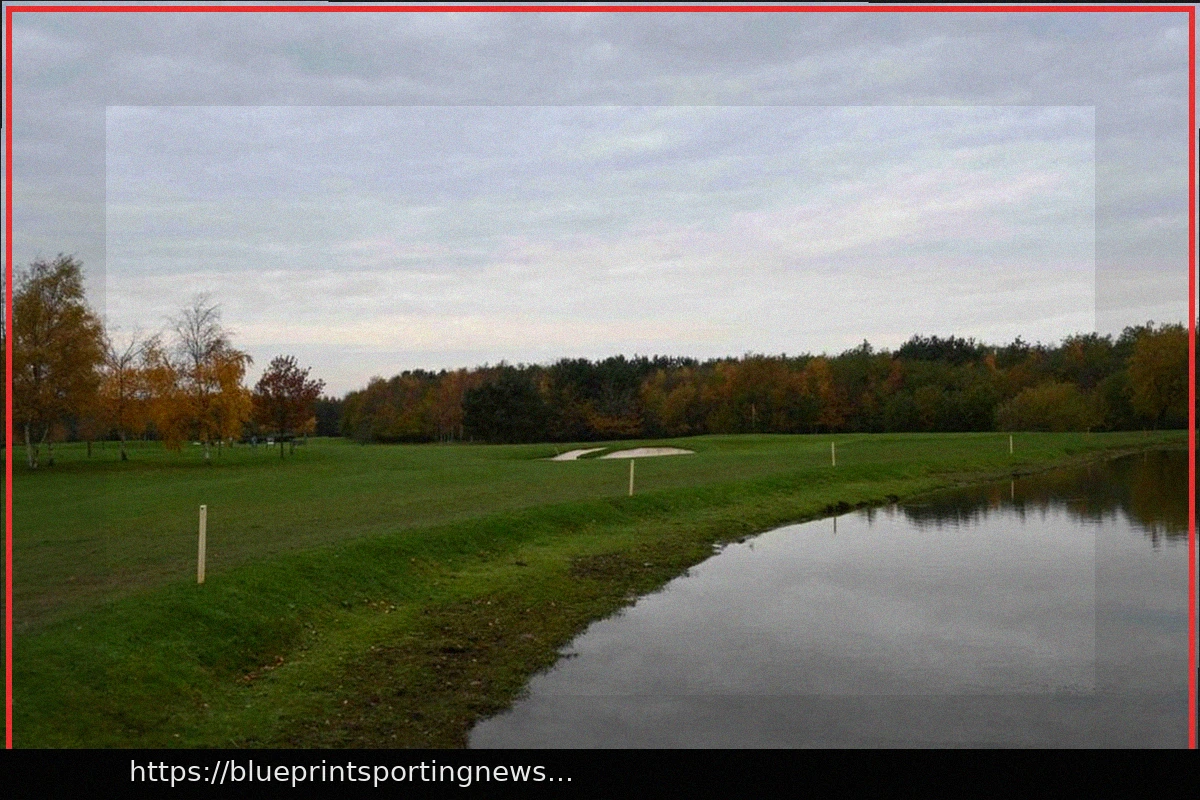
Every golfer has experienced the agony of hitting a ball that splashes into a water hazard. Penalty areas, however, aren’t always ponds and don’t necessarily contain water. They are one of the five distinct areas of a golf course as defined by the Rules of Golf and impact every player.
It’s common knowledge that there are two types of these areas: red and yellow.
This distinction isn’t arbitrary; there’s a significant difference between the two colors. Red markings offer a lateral relief option (within two club-lengths), whereas a yellow penalty area typically restricts relief options to stroke-and-distance or back-on-the-line.
So, how is the color determined? How does a golf club decide whether to mark a penalty area red or yellow? For anyone who has pondered this question, the answer lies within the committee procedures detailed in the Official Guide to the Rules of Golf.
Red or Yellow: How Are Penalty Areas Marked?
The R&A and USGA recommend that most penalty areas should be marked red. This preference is based on two primary reasons: first, to offer golfers the lateral relief option, and second, to minimize confusion during a round of play.
Consistent marking of penalty areas helps players avoid uncertainty about which relief options are available. If areas are red, golfers can readily understand that all possible relief options are at their disposal.
Nevertheless, there are specific situations where the nature of a hole might lead a competition committee to consider an alternative.
The Official Guide’s course marking guidance for penalty areas describes scenarios where a key challenge involves carrying the ball over water.
An illustrative example is a stream crossing the front of the putting green, where there’s a significant chance a ball carried over it could roll back in.
If successfully executing such a shot is crucial to how the hole is intended to be played, committees have the discretion to mark that penalty area yellow.
This implies that “a ball landing on the far side of a penalty area and then rolling back into it cannot be dropped on that far side using the lateral relief option.”
The Committee Procedures also stipulate that for yellow-marked areas, competition organizers must ensure that players have the option of back-on-the-line relief.
To facilitate this, Rule 17.1d (2) states that players must keep the estimated point where the ball last crossed the edge of the penalty area directly between the hole and the spot where the ball is dropped.
This often necessitates moving back in a direction that might not align with the usual line of play. If this option is not feasible, a player’s sole alternative in a yellow penalty area would be to take stroke-and-distance relief.
In scenarios where this situation is likely, committees may consider adding a designated drop zone for that penalty area to provide players with an additional option.
Can a Penalty Area Be Both Red and Yellow?
Yes, this is permissible. Committees might choose this dual marking for extensive penalty areas or those that transition, such as a pond flowing into a stream.
It’s crucial to remember that your relief options are “based on where the ball last crossed the edge of the penalty area, not where it ultimately came to rest within it.”
If you’ve ever observed red and yellow stakes placed one above the other, it’s because clubs are advised to use both colors to indicate where the nature of the penalty area changes.
It’s even possible to define a penalty area differently based on the tees being used, meaning the colors could vary depending on the specific tees from which players are starting.
“However, this practice is not recommended when multiple tees are used for the same competition.”