

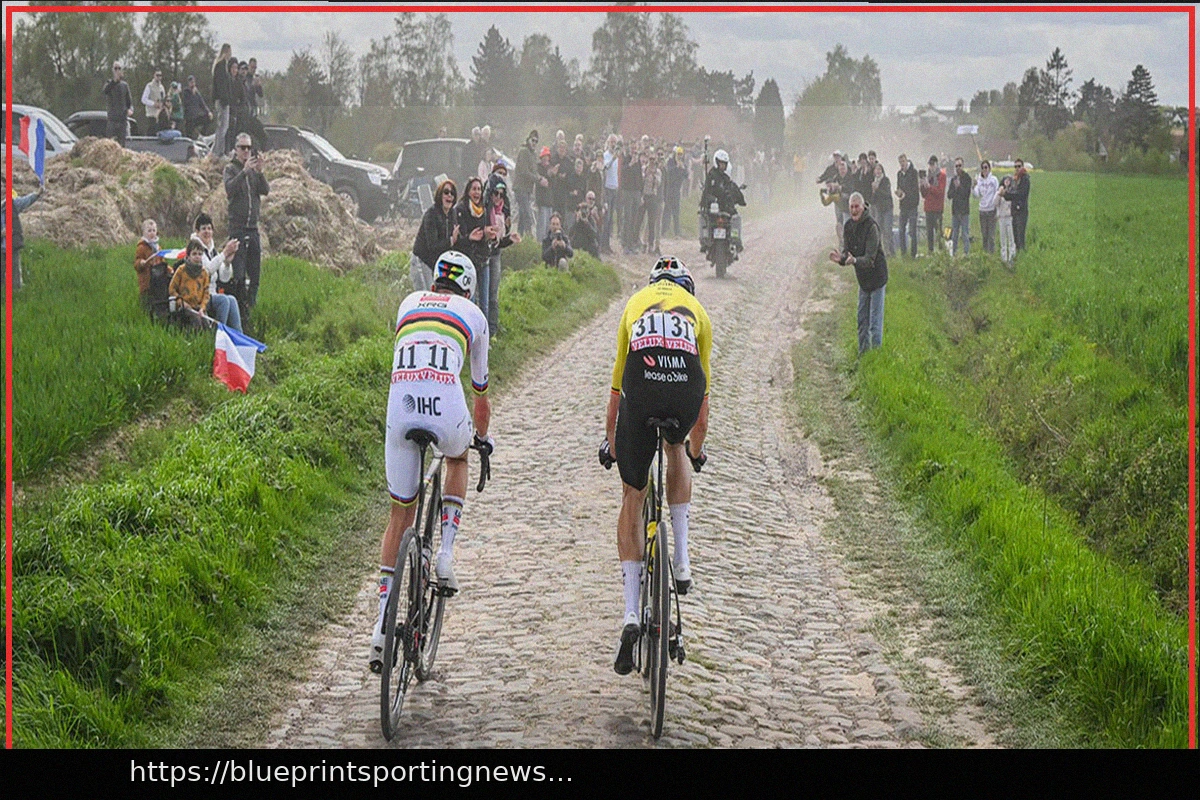
The legendary Paris-Roubaix, also known as the Hell of the North, delivered an exceptionally chaotic and grueling edition. Wout van Aert emerged victorious, securing his long-awaited win after a thrilling two-man sprint against Tadej Pogačar on the Roubaix velodrome. The race was marked by numerous punctures, crashes, and unforeseen difficulties that reshuffled the standings, leaving riders like Mathieu van der Poel to contend with adversity and ultimately finish fourth.
The race began with high intensity from Compiègne, covering 259 kilometers with thirty brutal cobbled sectors, including iconic stretches like the Arenberg Forest, Mons-en-Pévèle, and Carrefour de l’Arbre. Early breakaway attempts failed to gain significant ground, and the race truly fractured once the peloton hit the pavé, with mechanical issues and flat tires playing a significant role in shaping the race narrative.
Tadej Pogačar encountered a major setback with a puncture, forcing him into a substantial chase and even a stint on a neutral service bike before rejoining his own team. Adding to the drama, Mathieu van der Poel suffered multiple punctures in the Arenberg sector, costing him valuable time and effectively ending his hopes of a fourth Roubaix victory. Despite a strong effort to recover, the Dutchman spent the remainder of the race trying to catch up.
The decisive phase of the race unfolded in the final 60 kilometers when Van Aert launched a powerful attack, and Pogačar responded, eventually breaking away together. The duo quickly established a lead over the rest of the field, including riders like Mads Pedersen. Behind them, chasers such as Van der Poel and Filippo Ganna struggled to coordinate their efforts due to further incidents.
Throughout the challenging sectors of Mons-en-Pévèle and Carrefour de l’Arbre, Pogačar attempted to dislodge Van Aert, but the Belgian remained steadfast, glued to his rival’s wheel. The gap to the chasers remained manageable, keeping the pressure on but not enough to allow them back into contention.
As they entered the Roubaix velodrome, a two-man sprint was set to decide the winner. Van Aert strategically avoided contributing to the pace in the final kilometers, forcing Pogačar to lead out. With half a lap remaining, Van Aert launched his decisive sprint, opening an immediate gap that Pogačar could not close. After years of close calls, Van Aert finally claimed the prestigious Roubaix crown.
Jasper Stuyven secured third place in the sprint, while Van der Poel managed to salvage fourth after a day plagued by misfortune. For Pogačar, his second-place finish marked his first defeat of the season but also demonstrated his strong capability in the grueling Paris-Roubaix. For Van Aert, it was a moment of redemption and validation on one of cycling’s most unforgiving stages.
Key takeaways from the race include Van Aert’s hard-earned victory, Pogačar’s impressive debut performance and potential for future wins at Roubaix, Van der Poel’s race being undone by mechanical issues rather than a lack of strength, and the defining role of chaos and punctures in this brutal 2026 edition.