

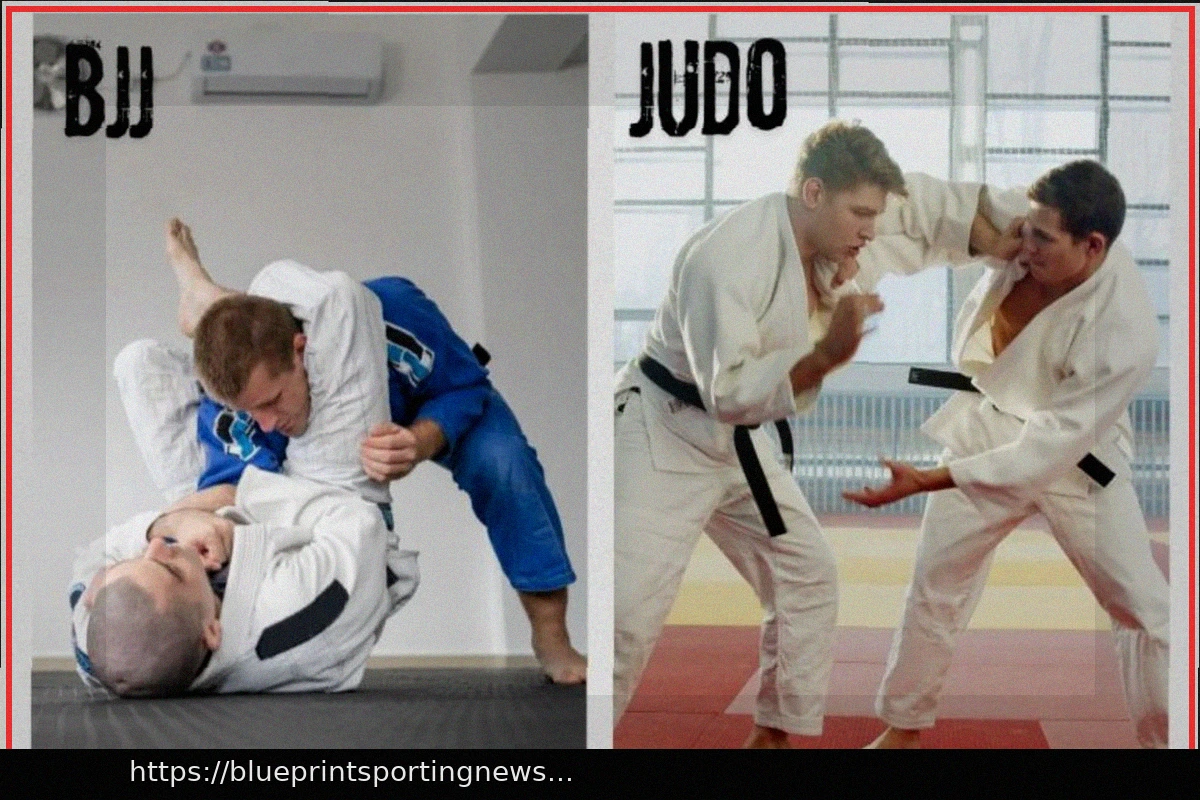
While sharing common roots, uniforms, and mats, judo and Jiu-Jitsu are distinct disciplines with differing philosophies, rules, and winning strategies. Let’s break them down.
What is Judo?
In its purest form, judo is a martial art focused on using an opponent’s power and momentum to bring them to the ground. A decisive throw, known as an ‘Ippon,’ immediately ends the match without any need for follow-up actions or points. It’s a swift and conclusive victory.
Founded by Jigoro Kano in 1882, judo evolved from traditional Jujutsu into a more structured sport. It became an Olympic sport in Japan in 1964 and is now governed by the International Judo Federation, with over 200 member countries.
Judo’s Scoring System:
- Ippon: An immediate win through a throw, a 20-second pin, or a submission.
- Waza-ari: A half-point awarded for a significant throw or hold. Two Waza-ari equal an Ippon.
- Shido: A penalty for passivity or rule infringements.
Matches for senior men typically last 4 minutes. In the event of a tie, sudden death overtime without a time limit can occur. The 2025 World Championships in Budapest saw 556 judges from 93 countries, with Georgia winning its first Mixed Team World title, highlighting the global evolution of competitive judo.
Jiu-Jitsu: A Different Approach to Problem Solving
Brazilian Jiu-Jitsu (BJJ) incorporates elements of ground fighting that are less emphasized in judo, developing into its own distinct sport. Its origins trace back to Brazil in the early 20th century, with roots in the early 1900s when judo master Mitsuie Maeda, who trained at Kodokan in Japan, emigrated and taught Carlos Gracie his skills.
The International Jiu-Jitsu Federation (JJIF) organizes competitions, and their scoring system reflects a strategy-focused philosophy:
Jiu-Jitsu’s Scoring System:
- Takedown: 2 points
- Guard Pass: 3 points
- Mount or Back Control: 4 points
- Submission: Immediate win
Matches in Jiu-Jitsu are longer, ranging from 5 to 10 minutes depending on belt level, allowing for a more deliberate, strategic pace. The focus is on setting up and executing techniques to achieve a dominant position or submission.
Key Differences Between Judo and Jiu-Jitsu
The core distinction lies in where the fight is primarily contested: standing or on the ground.
Judo emphasizes standing techniques. Throws like Uchi Mata, Seoi Nage, and Harai Goshi are among the most technically intricate in combat sports. Elite judoka can change the course of a match in an instant with a well-executed throw.
If a judo match goes to the ground, the referees follow a different logic. A hold needs to be established and maintained for approximately 10-15 seconds to be significant. If nothing decisive happens, the referee will often stand the competitors back up, actively discouraging prolonged ground exchanges.
Jiu-Jitsu, conversely, thrives on the ground. A practitioner on their back, controlling an opponent with their legs (in guard), is often in a dominant position. From here, they expertly seek submissions like armbars, chokes, and leg locks. The ground game is paramount.
This fundamental difference explains why many mixed martial artists train in both disciplines: judo addresses the challenge of getting an opponent to the ground, while Jiu-Jitsu provides the expertise for what to do once there.
The President’s Cup: A Competition for All Levels
The U.S. President’s Cup in judo is a significant national tournament. The 2025 edition was held over three days in November in Irving, Texas, offering qualifying opportunities for Senior Level C, Junior Level 3, veterans, and visually impaired athletes.
What makes the President’s Cup noteworthy is its inclusivity. It serves not only elite senior athletes but also juniors, veterans, and visually impaired competitors, fostering a more robust development ecosystem than many other judo competitions.
The 2026 President’s Cup is scheduled for November 22nd, also in Irving, providing a final qualification opportunity before the year’s end.
Deep Dive into Techniques: Standing vs. Ground
The technical divergence between these sports necessitates years of adjustment for athletes transitioning between them.
Both disciplines require precise entries and the disruption of an opponent’s balance for effective throws. Judo’s emphasis on biomechanically sound entries makes its techniques highly transferable to combat sports like MMA, where raw power can’t always compensate for technical efficiency.
Jiu-Jitsu’s ground hierarchy is structured differently. Control is established before offensive actions are taken. The typical sequence involves securing a position and then initiating submission attempts. A defensive guard against an experienced Jiu-Jitsu player can lead to extended periods of technical pressure, something that would be quickly resolved in judo.
The Current Landscape of Competition
Judo’s Olympic status provides a structured global competitive framework. The Judo World Tour features Grand Prix and Masters tournaments across five continents, serving as direct Olympic qualifiers. The 2025 season included a World Championship in Paris with a record 2316 participants from 64 countries, alongside cadet and junior world championships in Bulgaria and Peru.
The inclusion of ‘No-Gi’ (without a kimono) grappling on some event menus attracts athletes new to kimono-based competition, indicating the sport’s broader appeal and development.
Can and Should You Practice Both Disciplines?
Many dedicated athletes do cross-train, but the transition is gradual and challenging.
Judo practitioners transitioning to Jiu-Jitsu often struggle with the ground game. Being taught to remain upright, sitting or lying down is initially counter-instinctive. It takes months to become comfortable and proficient on the mat.
Conversely, Jiu-Jitsu practitioners often find the standing phase in judo challenging. The intricacies of grips, footwork, and the explosive pace of takedown entries present a different set of athletic demands. Most Jiu-Jitsu players starting judo begin with basic throws and build from there.