

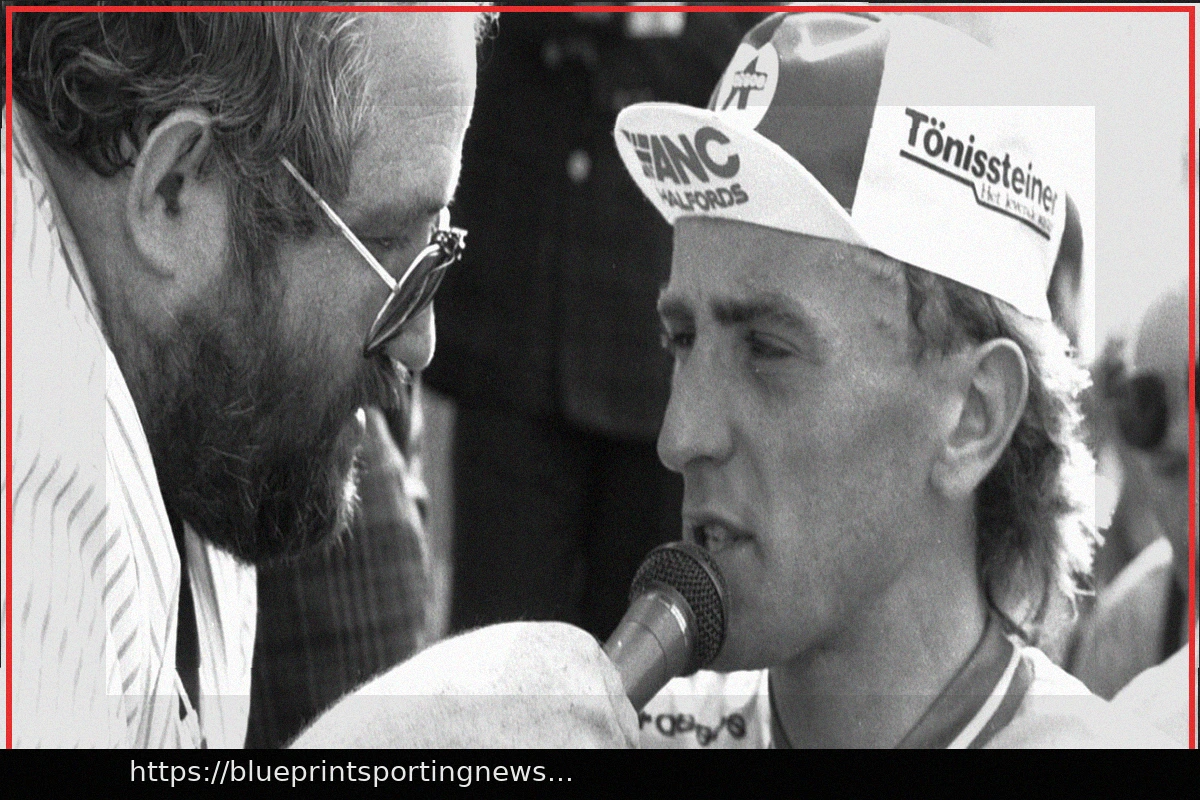
Before the era of multi-million pound professional cycling teams like Sky, a pioneering British outfit, ANC, made its mark on European racing. Despite eventual difficulties, the team demonstrated the potential for British riders on the continental stage. A highlight of this period was Malcolm Elliott’s third-place finish in the 1987 Amstel Gold Race.
The founder of the ANC team, Tony Capper, an unlikely figure in the cycling world due to his background and habits, displayed considerable ambition. In 1987, he achieved what took another 25 years and significant investment for Team Sky: getting a British team into the Tour de France. More impressively, Capper’s team also secured spots in prestigious European races like Paris-Nice and Liège-Bastogne-Liège. While facing challenges, the team delivered notable performances, including Elliott’s strong showing at the 1987 Amstel Gold Race.
The Amstel Gold Race, the Netherlands’ sole one-day classic, is fiercely defended by the home nation, which had secured numerous victories. Prior to 1987, only legendary riders like Merckx, Maertens, and Hinault had managed to win the race from outside the Netherlands. In 1987, it took three of Holland’s top cyclists to prevent the then 25-year-old Malcolm Elliott, a fast finisher from Sheffield riding for the less-established ANC squad, from claiming victory.
Elliott’s recollection of the race is hazy regarding the early stages, but he remembers the decisive final 20-30 kilometers. The race, held in the hilly South Limburg region of the Netherlands, is characterized by numerous climbs. Elliott, who had previously won the British Hill Climb Championship and been part of a world record-holding pursuit team at the Moscow Olympics, was no stranger to climbing.
Recalling the pivotal moment, Elliott described how, approaching the Cauberg climb, riders Steven Rooks and Teun Van Vliet of PDM and Panasonic, respectively, increased the pace, creating a gap. Joop Zoetemelk, the 1980 Tour de France winner and 1985 World Champion, followed, and Elliott positioned himself behind Zoetemelk, successfully bridging the gap to form a leading group of five, including Bruno Cornillet.
Elliott noted that the pace wasn’t excessively high, and riders were cautiously taking turns. However, Zoetemelk launched a decisive solo attack, leaving the others hesitant. The gap widened, becoming too significant for any single rider to close.
It became apparent that a victory for the celebrated Dutch rider Zoetemelk would be more favorable to the race organizers, the Dutch media, and the home crowd than an outsider winning. Additionally, it’s suggested that Zoetemelk may have owed Rooks a favor, allowing him to slip away. Elliott mentioned that he had underestimated Zoetemelk’s move, having been focused on Van Vliet, whom he believed had worked with Rooks and Zoetemelk.
In the final sprint, Rooks surprised Elliott by attacking for second place. Elliott, however, managed to decisively outsprint Van Vliet for third, with Cornillet finishing fifth.
Elliott stated that he didn’t receive significant fanfare at the finish line. The focus was entirely on the home hero, Joop Zoetemelk, winning his national classic. There wasn’t even a discernible podium ceremony.
Reflecting on the race, Elliott admitted that hindsight offered possibilities. He suggested that a financial arrangement with Rooks for a “straight” sprint might have been considered, but acknowledged the substantial cost involved. He also expressed disappointment that Dutch rivalries didn’t play out to his advantage.
Interestingly, Elliott later heard that Rooks and Van Vliet had argued before the finish, with one seeking repayment of a favor from a previous race, which the other refused due to the prestige of the Amstel Gold Race in the Netherlands.
Malcolm Elliott went on to have a highly successful career as a sprinter, achieving multiple stage wins and jersey classifications in races like the Vuelta a España, Tour of Britain, and various Spanish and American tours. He even returned to professional racing in the UK as a veteran, winning the Premier Calendar competition against much younger opponents.
As for Tony Capper, he disappeared from the cycling scene during the 1987 Tour de France, leaving behind unpaid debts and a collection of “Capper stories.” However, his role in the history of British cycling is undeniable, as is Malcolm Elliott’s significant achievement in the 1987 Amstel Gold Race.
(This article is a tribute to the late Ed Hood, a cherished colleague and contributor to PEZ Cycling News.)