

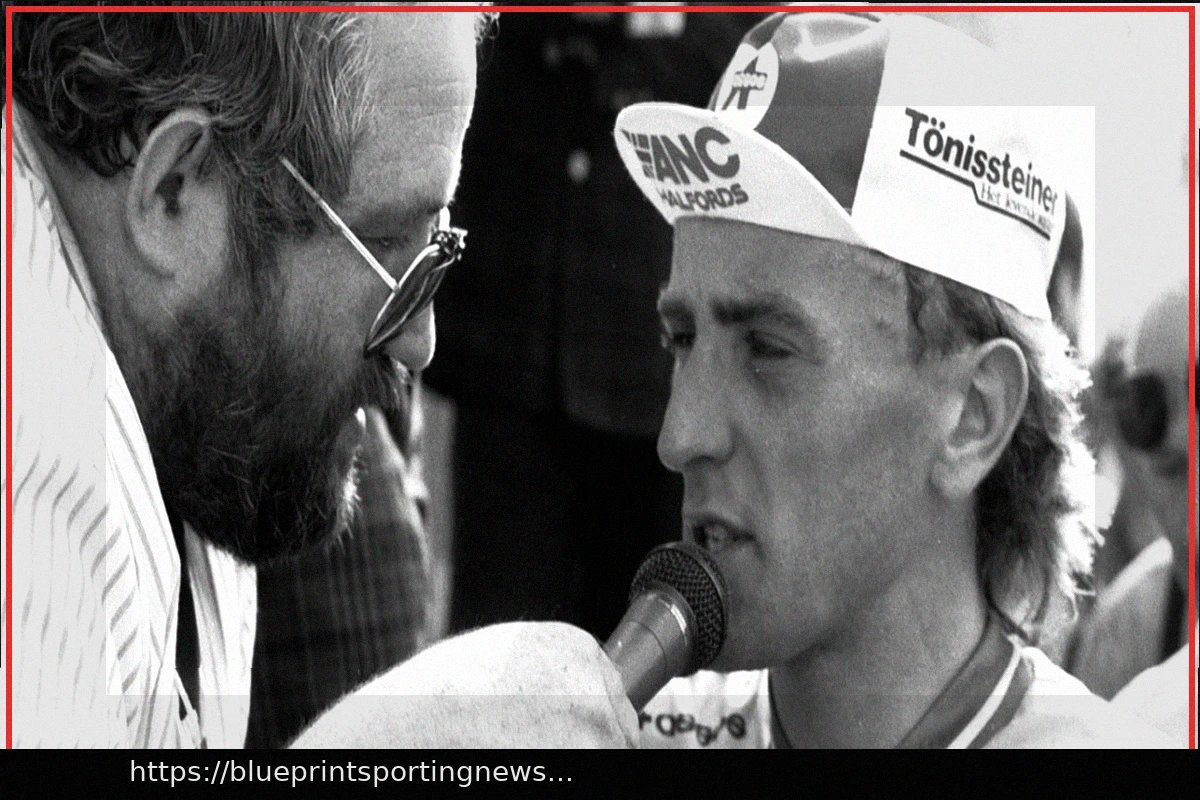
Two decades before the well-funded Sky Team competed in the WorldTour, a groundbreaking British squad, ANC, challenged continental professionals on their home turf. Despite later facing difficulties, the ANC team demonstrated the potential for British cycling. A significant achievement for the team was Malcolm Elliott’s third-place finish in the 1987 Amstel Gold Race.
The unconventional ANC team manager, Tony Capper, was undoubtedly ambitious. This former police officer, who founded, developed, and sold the ANC transport company during the 1987 Tour de France, was an unlikely figure to establish a cycling team, given his considerable weight and chain-smoking habit, appearing to embody an anti-fitness persona.
In 1987, Capper achieved what took the immense financial backing of Team Sky some 25 years later: he got a British team into the Tour de France. More than that, he managed to secure the team’s participation in prestigious European races like Paris-Nice and Liège-Bastogne-Liège. While the team endured criticism, they also produced performances of genuine quality, including the race we are focusing on: the 1987 Amstel Gold Race.
The Dutch are very protective of their sole classic race, the Amstel Gold. The Amstel River lends its name to Amsterdam, and Amstel Gold is the popular beer that sponsors the event. In the first 21 editions of the race, Dutch riders secured 11 victories. The remaining 10 Amstel Golds were won by cyclists of the caliber of Merckx, Maertens, and Hinault, who managed to claim the honors outside of the Netherlands.
In 1987, it required three of the Netherlands’ top riders to prevent a charismatic 25-year-old from Sheffield, Malcolm Elliott, from bringing the victory across the North Sea to England. Elliott was riding for Capper’s underdog ANC squad. However, following a spirited performance in the 1986 Nissan Tour of Ireland, the exceptionally talented Englishman was not entirely unknown to some continental riders, who mentally noted fast finishers.
The Amstel Gold Race takes place in South Limburg, a region characterized by its undulating terrain with one climb following another. The 2016 edition, for instance, featured 34 ascents. Perhaps it was fortunate that Malcolm “doesn’t remember much about the race except for the last 20 or 30 kilometers, it was 30-odd years ago after all!”
However, Elliott was no stranger to climbing. He had won the British Hill Climb Championship on the challenging Nick O’Pendle climb in 1980. In the same year, he was part of the team that, albeit briefly, held the world record for the four-kilometer team pursuit at the Moscow Olympics.
Elliott recounts his experience: “Coming onto the Cauberg climb in the closing stages of the Amstel, there was a bit of a lull. Then Steven Rooks (PDM and Holland, twice Dutch professional champion and winner of the Amstel and Liège-Bastogne-Liège) and Teun Van Vliet (Panasonic & Holland, winner of Het Volk and Gent-Wevelgem) went to the front. They didn’t launch a fierce attack, but they increased the tempo slightly and began to open a gap. Joop Zoetemelk (Superconfex and Holland, 1980 Tour winner and 1985 World Champion) moved to catch them. I tucked in behind him, and we bridged the gap.”
“I must have had good legs because it didn’t feel like we were going at full speed, but we soon had a 30-second gap. Bruno Cornillet (Z-Peugeot and France, winner of the Tour of Valencia and the Circuit de la Sarthe) came up, making it five of us up the road.”
“It didn’t feel like we were expending all our energy; no one seemed fully committed, but there were small accelerations. We all kept taking turns at the front to maintain momentum. Zoetemelk went to the front – I think Rooks was behind him. He just rode off the front. We all hesitated, looked at each other, and the gap grew: five seconds, then ten, then 20. It became too much for one rider to bridge on their own.”
What Elliott didn’t realize was that a victory for the veteran Dutchman would have been far more favorable for the race, the Dutch media, and the home fans than an win by an unknown foreigner. It also implied that Rooks was due a “favor” from Zoetemelk by allowing him to ride off the front – Zoetemelk had won the 1985 World Championships in a similar fashion.
“I can’t remember why, but I had it in my head that Van Vliet was the rider to watch because I thought he had paid off Rooks and Zoetemelk, so I didn’t imagine it would be the race-winning move. In the end, Rooks surprised me and broke away for second place. I put ten lengths into Van Vliet to take third place comfortably, with Cornillet back in fifth.”
When asked if he received much attention at the finish line for achieving a major result as an outsider, Elliott explained: “Not really. I don’t even remember there being a podium; all eyes were on Dutch hero Joop winning his home classic.”
When I informed Elliott that an “insider” had once suggested that the Englishman should have spoken to Rooks and offered him money in exchange for a “straight” sprint, Elliott responded:
“Hindsight is a wonderful thing. I think it would have cost me a couple of years’ salary to secure that deal. They all knew I could sprint; they had seen me at the Nissan in ’86. After the race, I was quite happy with the ride, but you can’t help but think about how things might have unfolded. I had hoped that Dutch rivalries might have played a role, and I could have benefited, but it didn’t work out that way.”
“Just the other year, I heard that Rooks and Van Vliet had been arguing coming into the finish that day. One of them had done the other a favor at Het Volk and wanted it repaid, but the other refused because the Amstel is such a significant event in the Netherlands.”
As mentioned, the Dutch riders are reluctant to relinquish the Amstel Gold easily.
Elliott went on to become a highly successful road sprinter for teams like Teka and Fagor, winning stages and the points jersey in the Vuelta, stages in the Tour of Britain, the Sun Tour in Australia, Tours of Aragon, Galicia, and The Mining Valleys, the Semaine Catalan, Trofeo Castilla y Leon, Trofeo Cantabria, and Pais Vasco, all in Spain – as well as numerous races in the USA with LA Sheriffs later in his career.
He made a professional comeback in the UK as a veteran pro with Pinarello, winning the season-long Premier Calendar competition against riders half his age.
What about Capper?
He vanished back to his tax haven on the Isle of Man after abandoning his ANC team during the 1987 Tour de France, leaving behind numerous unpaid bills and a thousand “Capper stories.” However, his place in British cycling history is assured, as is Malcolm Elliott’s in the Amstel story.
—
English Translation:
Malcolm Elliott Talks Amstel ’87!
Twenty years before the multi-million pound Sky Team rode the WorldTour, there was another ‘ground breaking’ British team that took on the Continentals in their own back-yard. The ANC team had its eventual problems, but it showed what was possible. One high point was Malcolm Elliott’s 3rd place in the 1987 Amstel Gold Race.
There are many things you can say about maverick ANC boss, Tony Capper but a lack of ambition wasn’t one of them. The ex-policeman who founded, built and then sold – during the 1987 Tour de France – the ANC transport company was an unlikely candidate to start a cycling team, hugely over-weight and a chain smoker he seemed ‘anti-fitness’ personified.
But he did in 1987 what it took the Murdoch millions to do some 25 years later with Team Sky – in getting a British team into the Tour de France. But not just Le Tour, he somehow got the team into some of Europe’s greatest races – like Paris-Nice and Liège-Bastogne-Liège. There were the inevitable ‘kickings’ but there were also rides of real quality, including the one we’re about to look at; the 1987 Amstel Gold Race.
The Dutch are pretty protective of their only classic – the Amstel is Amsterdam’s river and Amstel Gold is the popular beer which sponsors the race – of the first 21 editions of the race the home nation took 11 wins. Of the other 10 Amstel Golds it took riders of the quality of Merckx, Maertens and Hinault to wrest the honours out of the Netherlands.
And in 1987 it took three of Holland’s finest riders to stop a handsome, blond 25-year-old from Sheffield taking the honours across the North Sea to England. Malcolm Elliot was riding for Capper’s minnow ANC squad but due to a combative performance in the 1986 Nissan Tour of Ireland the multi-talented Englishman wasn’t an unknown quantity to some of the continentals who always take a mental note of a fast finisher.
The Amstel Gold takes place in South Limburg so it’s anything but flat, one ‘berg’ follows another – the 2016 edition will see 34 climbs – so maybe it’s just as well Malcolm; ‘Doesn’t remember much about the race except for the last 20 or 30 kilometres, it was 30-odd years ago after all!’
But Elliott was no stranger to hills, winning the British Hill Climb Championship on the savage Nick O’Pendle climb in 1980, the same year he’d been in the team which – albeit briefly – held the world record for the four kilometre team pursuit at the Moscow Olympics.
Elliott takes up the story; “Coming on to the Cauberg climb in the closing stages of the Amstel there was a bit of a lull then Steven Rooks (PDM and Holland, twice Dutch pro champion and winner of the Amstel and Liege-Bastogne-Liege) and Teun Van Vliet (Panasonic & Holland, a winner of Het Volk and Gent-Wevelgem) went to the front, they didn’t put in a fierce attack, but they did up the tempo a little and began to open a gap, Joop Zoetemelk (Superconfex and Holland, 1980 Tour winner and 1985 World Champion) moved to get on to them, I tucked in behind him and we bridged-up.”
“I must have good legs because it didn’t feel like we were flying but we soon had a 30 second gap, Bruno Cornillet (Z-Peugeot and France, a winner of the Tour of Valencia and the Circuit de la Sarthe) came up and that made five of us up the road.”
“It didn’t feel like we were riding our legs off, no one seemed fully committed but there were little jumps going in, we all kept rolling-through though to keep the momentum going. Zoetemelk went to the front – I think it was Rooks who was behind him – he just rode off the front, we all hesitated, looked at each other and the gap grew, five seconds, then ten, then 20 then it was too much for one rider to bridge on their own.”
What Elliott hadn’t realised was that a win by the veteran Dutchman was much better for the race, the Dutch media and the home fans than some unheard of foreigner; and also meant that Rooks was due ‘a favour’ from Zoetemelk in letting him ‘drift’ off the front – Zoetemelk won the 1985 Worlds in much the same way.
“I can’t remember why but I had it in my head that Van Vliet was the guy to watch because I thought that he had paid-off Rooks and Zoetemelk so I didn’t imagine it would be the race-winning move. At the death Rooks took me by surprise and jumped away for second place but I put ten lengths into Van Vliet to take third place easily with Cornillet back in fifth.”
I asked if he was made a fuss of at the finish as an outsider grabbing a big result and Elliott explained; “Not really, I don’t even remember there being a podium, all eyes were on Dutch hero Joop winning his home classic.”
When I told Elliott him that someone “in the know” once said to me that what the Englishman should have done was to have spoken to Rooks and suggested to him that he would hand-over some cash in exchange for a ‘straight’ sprint but as the man himself says;
“Hindsight is a great thing, I think it would have cost me a couple of years salary to get that deal, they all knew I could sprint, they had seen me at the Nissan in ‘86. After the race I was pretty happy with the ride but you can’t help but think about how things might have gone, I had hoped that Dutch rivalries might have come in to play and I could have benefited but it didn’t work out like that.”
“Just the other year though I heard that Rooks and Van Vliet had been arguing coming in to the finish that day, one of them had done the other a favour at Het Volk and wanted it repaid, but the other wouldn’t do it because the Amstel is such a big deal in The Netherlands”
Like I said – those Dutchmen don’t like to let go of that Amstel Gold easily.
Elliott would go on to be a highly successful road man sprinter in the colours of teams like Teka and Fagor winning stages and the points jersey in the Vuelta, stages in the Tour of Britain, Sun Tour in Australia, Tours of Aragon, Galicia and The Mining Valleys, the Semaine Catalan, Trofeo Castilla y Leon, Trofeo Cantabria and Pais Vasco, all in Spain – as well as a raft of races in the USA with LA Sheriffs later in his career.
He would ‘come back’ as a professional in the UK as a veteran pro with Pinarello and win the season-long Premier Calendar competition against men half his age.
Capper?
He disappeared back to his tax haven on the Isle of Man having abandoned his ANC team during the 1987 Tour de France, leaving dozens of unpaid bills and a thousand ‘Capper stories.’ But his place in British cycling history is assured as is Malcolm Elliott’s in the Amstel story.