Penguins' Koivunen Commitment Could Make Justin Brazeau Expendable
The Pittsburgh Penguins' substantial commitment to Ville Koivunen might compel Kyle Dubas to make another significant decision, and a trade involving Justin Brazeau appears to be the most straightforward solution.
Pittsburgh secured Koivunen with an eight-year, $32 million contract on August 6th. At 23 years old and with only 14 NHL points to his name, Koivunen now holds the longest contract on the team's roster. Last season, Koivunen registered a modest two goals and seven points in 39 NHL games. However, his performance in the American Hockey League (AHL) with the Wilkes-Barre/Scranton Penguins, where he scored 13 goals and accumulated 41 points in 34 games, demonstrates the organization's continued faith in his offensive potential.
This contract makes it increasingly challenging for Pittsburgh to keep Koivunen out of the regular lineup. Adding to the existing competition within a crowded forward group, the Penguins have already acquired Andrei Kuzmenko, Nicholas Robertson, and Hendrix Lapierre this offseason. The addition of Koivunen's new deal further intensifies this situation.
It's likely that one player will eventually be displaced. Justin Brazeau stands out as the most probable candidate for a trade. Moving him would create a necessary roster opening without forcing Pittsburgh to sacrifice one of its more crucial veteran players or promising young assets with long-term potential.
Brazeau's Value Could Generate Trade Interest
Trading Brazeau wouldn't be about shedding an undesirable contract; in fact, his production should make him an attractive option for other teams.
Last season, Brazeau achieved career highs with 17 goals and 17 assists, totaling 34 points in 64 games. Despite generally playing in a bottom-six role, he averaged an impressive 0.53 points per game, providing Pittsburgh with valuable secondary offense at a reasonable cost.
His current contract further strengthens the argument for a trade. Brazeau is entering the second year of a two-year, $3 million deal with a $1.5 million salary cap hit. He is set to become an unrestricted free agent after the 2026-27 season.
This combination of affordability and production could appeal to teams seeking inexpensive scoring depth.
A contending team would not have to take on a significant salary or commit to a long-term deal. Brazeau's versatility allows him to play both wing positions, adds size near the net, and he has already proven his ability to produce in a limited capacity. Furthermore, Pittsburgh would be trading him after his most productive NHL season, rather than waiting for his value to potentially diminish.
It's worth acknowledging that some regression is possible. Brazeau's scoring pace slowed after a strong start last season, and injuries affected his second half. Recent analyses have suggested that repeating his 17-goal performance might be challenging.
This could present an opportune moment to explore his market value.
Koivunen Requires Brazeau's Spot More Than Pittsburgh Needs Cap Space
The Penguins are not in a position where they need to trade Brazeau for financial relief. However, they may need the roster spot he occupies.
A recent projection of the Penguins' 2026-27 roster listed Brazeau on the fourth line but noted that his position was far from secure. Players like Elmer Soderblom could compete for the same role, while Lapierre, Rutger McGroarty, and Koivunen all require playing time. This projection was made before Pittsburgh committed to Koivunen's eight-year contract.
This contract extension fundamentally alters the equation. Pittsburgh can no longer view Koivunen as just another young forward fighting for a roster spot. The organization has made a significant investment, believing that his AHL success will translate into meaningful offensive contributions at the NHL level.
Previously, it was argued that the Penguins needed a clear plan for Koivunen, especially since his development might be hindered by fourth-line minutes or inconsistent NHL play. The new contract elevates the urgency of this issue.
Koivunen needs opportunities in the top nine, offensive zone starts, and some power-play time. The Penguins will not gain a clear understanding of their $32 million investment if he is only playing eight minutes per night. Moving Brazeau would not automatically guarantee Koivunen that role, but it would remove one obstacle in his path.
Offseason Additions Have Altered Brazeau's Role
Brazeau's situation was more favorable when Pittsburgh acquired him in July 2025. The Penguins signed him to a two-year deal after he recorded 22 points in 76 games for the Boston Bruins and Minnesota Wild. His size, net-front presence, and affordable contract made him a reasonable gamble for Dubas in the bottom six.
However, the team's forward depth has significantly evolved in the past year.
Kuzmenko provides another experienced winger. Robertson was acquired from the Toronto Maple Leafs for a draft pick and signed to a two-year, $6.5 million contract. Lapierre cost Pittsburgh two future draft selections and was subsequently signed for two seasons.
Koivunen is now under contract through the 2033-34 season. McGroarty still needs an opportunity to prove himself, and Soderblom performed well enough after his arrival last season to remain in contention for a bottom-six role.
Brazeau now finds himself in a precarious position. He is productive enough that Pittsburgh would be reluctant to waive or demote him, yet he is not a crucial long-term piece who should block younger players needing NHL evaluation. This makes him more expendable now than he was at the start of the offseason.
Trading Brazeau Offers Dubas Several Avenues
Pittsburgh should not trade Brazeau merely to clear roster space. The team needs to receive tangible value in return.
His affordable contract and recent production could enable Dubas to pursue a future draft pick, a younger player at a different position, or use Brazeau as part of a larger trade package. While the Penguins don't desperately need another late-round pick, accumulating additional assets aligns with the roster transition Dubas has been managing.
The team could also address other areas of need. Pittsburgh has a surplus of forwards compared to available NHL roster spots, while questions remain on defense and in goal. Utilizing excess depth at one position to bolster another would be more strategic than having multiple forwards compete for limited opportunities.
There is also no obligation to make a trade immediately. Training camp could naturally resolve the situation. Injuries might create openings, and Koivunen still needs to prove his NHL readiness and justify a regular role. Dubas should refrain from trading a valuable 17-goal scorer until it's clear whether Koivunen, McGroarty, or Lapierre have truly earned Brazeau's spot.
The Penguins should be prepared to make the move if roster congestion becomes evident during training camp.
Brazeau Still Has a Case for Staying in Pittsburgh
Trading Brazeau would come at a cost. Seventeen goals from a player earning $1.5 million represents excellent value. Pittsburgh spent years searching for affordable secondary scoring, and trading away one of the players who finally delivered it could create a new problem.
Brazeau also brings a dimension that several of Pittsburgh's new forwards lack. His size and willingness to play physically around the net provide the Penguins with a different offensive approach. The organization doesn't need an entire bottom six composed solely of skill-oriented forwards.
Furthermore, his expiring contract means Pittsburgh faces minimal long-term risk by keeping him. If Koivunen struggles or another winger sustains an injury, Brazeau offers proven NHL insurance.
Therefore, the Penguins should avoid treating a trade as an inevitability. The argument is that Brazeau has become the most logical player to move if Pittsburgh decides someone must depart.
This distinction is significant.
Koivunen Extension Forces Penguins to Prioritize
Pittsburgh has focused on creating competition throughout the offseason. Koivunen's contract signifies that this competition must ultimately lead to clear winners and losers.
The Penguins did not commit $32 million to Koivunen with the expectation that he would remain behind every established forward on the depth chart. His 41 points in 34 AHL games suggest he has little left to prove at that level, while his seven points in 39 NHL games necessitate a larger sample size to determine the success of the investment.
Brazeau represents the most straightforward path to creating that opportunity. He is entering the final year of his contract, carries only a $1.5 million cap hit, and just scored 17 goals. These attributes make him valuable to Pittsburgh, but they also make him one of the few forwards with legitimate trade value who could be expendable.
Dubas should not trade Brazeau simply because the roster is crowded. However, if another team is willing to offer compensation for what Brazeau provided last season, Pittsburgh should certainly listen.
The Penguins have made it clear that Koivunen is a part of their long-term future. Their next roster move may need to ensure that there is indeed adequate space for him to play.
Fresh materials — NHL

Maple Leafs: Haymes and Blankenburg Compete for a Spot
As the Toronto Maple Leafs training camp nears, a compelling narrative is unfolding beyond the star players. It centers on individuals with everything to prove, arriving at camp without guaranteed positions. Luke Haymes and Nick Blankenburg exemplify this dynamic. Haymes, a young center,

The Sharks Need to Change Their Goal Song
The San Jose Sharks' 2025-26 season has been a major NHL story, marked by the rise of Macklin Celebrini and a resilient young team. After years at the bottom of the standings, the Sharks are now contenders with genuine playoff hopes for 2026-27. Fans are eager to move past a seven-year pl

Connor Ingram's Significant, Brief Stint with the Oilers
Connor Ingram spent only nine months with the Edmonton Oilers organization, occupying a dressing room stall for roughly half that time and playing 37 games. Despite this brevity, few players in Oilers history have had such a positive impact in such a short p
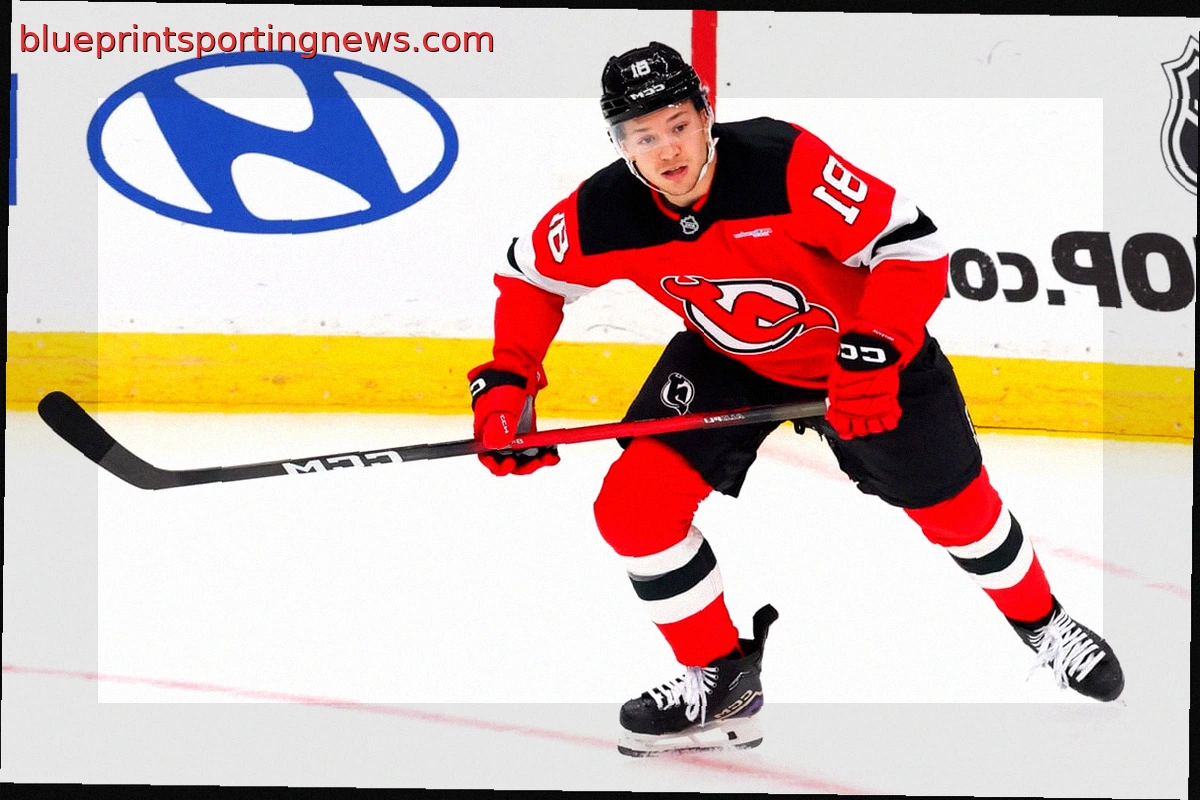
Arseny Gritsyuk 2026-27 Projections for New Jersey Devils
The New Jersey Devils face significant pressure for the 2026-27 season. Despite a strong roster, last year's late-season collapse and missed playoffs after a promising start fuel their determination to avoid a repeat. Every player has a defined role. As the season approaches,

5 St. Louis Blues Prospects to Watch at the Rookie Showcase vs. Blackhawks
The St. Louis Blues will have their first opportunity to see several of their top prospects in competitive action when they face the Chicago Blackhawks in a two-game rookie showcase. The games are scheduled for September 14th at 6 p.m. and September 15th at 4 p.m. at USG Arena, locate

3 Finnish Prospects to Watch at the 2026 NHL Prospect Games
Following a look at Finnish prospects at the Rookie Faceoff, the NHL Prospect Games, set to take place from September 12th to 15th at the BELFOR Training Center in Detroit, will feature the Red Wings hosting the Dallas Stars, Pittsburgh Penguins, and Columbus Blue Jackets. This event offers anoth